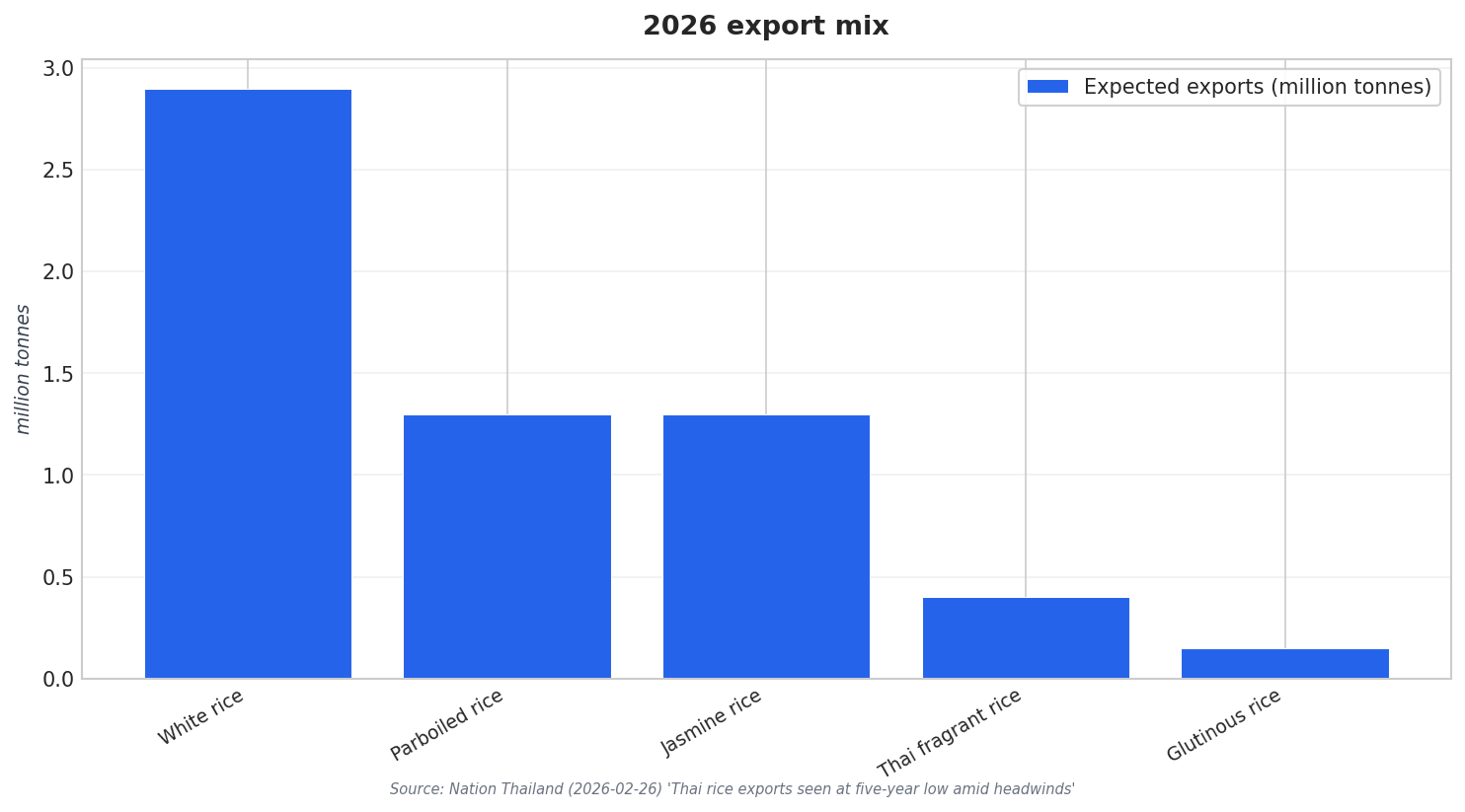
Thailand’s rice exporters are signalling a tougher year ahead as price competition intensifies and the baht remains a key headwind. The Thai Rice Exporters Association set a 2026 export target of 7.03 million tonnes worth THB130 billion, or about US$4 billion. The association described this as an 11% decrease from 2025, when exports reached 7.9 million tonnes, and noted the target would be the lowest in five years since 2021 if it materialises. Exporters also indicated the situation may be reassessed in the second half of 2026, depending on how market conditions and the currency evolve.
The early-year performance underscores the pressure. In January 2026, Thailand exported 530,287 tonnes, down 17.5% from 643,144 tonnes in the same month a year earlier. Export value fell to THB9.707 billion, a 30.7% decrease, or US$313 million, a 23.9% decrease, reflecting price pressure in the global market and intensifying competition. By type, white rice remained the largest category at 239,192 tonnes (down 14.8%), followed by jasmine rice at 120,913 tonnes (down 8.4%), parboiled rice at 72,462 tonnes (down 2.5%), and Thai fragrant rice at 29,390 tonnes (down 31%). Key January markets included Iraq, the United States, South Africa, Malaysia, Angola, Cameroon, Senegal, China, the Philippines, and Hong Kong.
A Strong Baht and Wider Price Gaps Are Reshaping Competitiveness
Exporters are focusing on the exchange rate because it directly raises offered prices in dollar terms. The association said an export-friendly rate would be around 33–34 THB per US$1, versus about 31 THB per US$1. It also warned that every THB1 appreciation makes 5% white rice US$12–15 per tonne more expensive, while fragrant rice becomes US$30–35 per tonne more expensive. Separately, exporters said the stronger baht has increased Thai rice prices versus competitors, and that compared with the same period in 2025, rice prices have increased by about US$40 per tonne due to currency moves. In this environment, benchmark 5% broken white rice from Thailand is about US$20 to US$30 per tonne more expensive than similar grades from India and Vietnam.
Premium pricing is also widening gaps in high-value segments. Thailand’s Hom Mali was cited at around US$1,110 per tonne, compared with roughly US$800 for Vietnam’s ST25. Another warning from exporters was that Thai jasmine rice has recently reached US$1,200 per tonne, higher than basmati at around US$970 per tonne, and higher than competitors such as Vietnam and Cambodia at US$800–830 per tonne. Exporters cautioned that jasmine rice could become the world’s most expensive and lose 15–20% of key markets, especially if the currency remains strong and rivals keep pricing aggressively.
Broader supply conditions are amplifying the pricing battle. Exporters pointed to rising global supply, especially from India, and said India has achieved record production of 152 million tonnes per year, surpassing China’s previous record of 145–146 million tonnes. Competitors including Vietnam and Pakistan also reported excellent harvests, contributing to supply outpacing demand and intensifying price competition. In this context, the Thailand rice export industry is weighing currency management alongside longer-term steps such as developing varieties with higher yields per rai and lowering production costs, aiming to better match global market needs while defending market share.
What export target did Thai exporters set for 2026?
How did Thailand’s rice exports perform in January 2026?
Why does the exchange rate matter so much for exporters?
How big are the price gaps versus India and Vietnam?
What is changing in the Thailand rice export industry’s market mix?