Thailand’s interest in Small Modular Reactors is gaining momentum as energy security and clean power considerations converge. A Krungsri Research note links renewed global attention to SMRs to the 2026 global energy crisis and describes SMRs as flexible designs with enhanced safety features that can support sustainability goals. In Thailand, SMR capacity previously appeared in the draft PDP2024, even as the final direction of the plan remains pending. The same source also flags hurdles that still shape the national debate, including public concerns over safety and a per-unit electricity cost that remains higher than several competing technologies.
On the policy-and-project side, PDP 2024 is described by NuclearBusiness Platform as targeting two 300 MW SMRs, totaling 600 MW, with construction beginning in 2032 and commercial operations expected by 2037. The plan assigns development and operation to the Electricity Generating Authority of Thailand (EGAT). It also splits capacity geographically, with 300 MW in the Northeast and 300 MW in the South, framed as a way to integrate nuclear at grid nodes that can absorb it without the kind of large-scale upgrades a single large plant would demand. For the Thailand small modular reactor industry, this creates a concrete timeline to plan around, while keeping siting and transmission practicality in view.
Chulalongkorn University Steps Up as a Talent and Safety Anchor
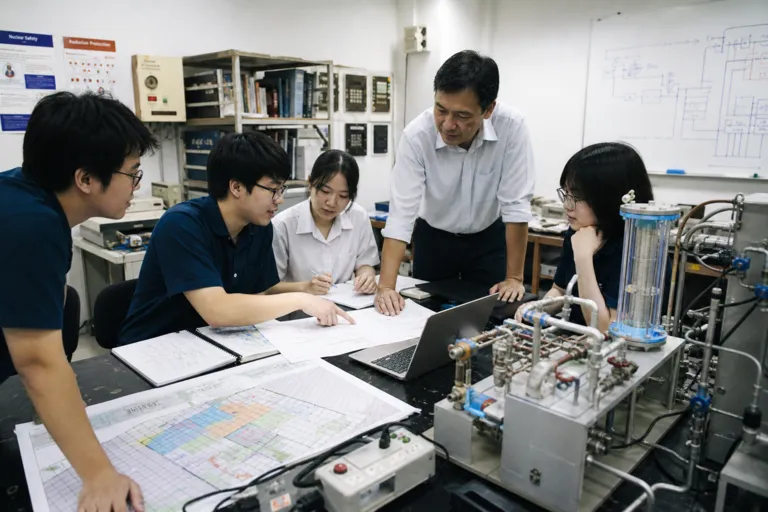
Chulalongkorn University is using its engineering capabilities to build readiness for SMRs by focusing on workforce and knowledge. PRNewswire and Newswise report that the university aims for carbon neutrality and is promoting nuclear energy and SMR technology, describing these as safer small-scale plants with zero carbon emissions. The same reports emphasize that Thailand’s long-standing personnel readiness and nuclear expertise have been developed over decades by the Department of Nuclear Engineering, Faculty of Engineering, which is described as the only institution in Thailand that offers education in nuclear engineering. That institutional continuity matters because SMRs are often discussed as a modern alternative to large reactors that carry stronger public associations with past disasters.
The technology framing in the sources is specific. One report explains that SMRs are modern nuclear power plants with a generating capacity of no more than 300 MW, compared with conventional nuclear plants that typically have around 1,000 MW. Krungsri Research adds a broader global context for why “newer” designs are emphasized, noting that third-generation reactors introduced passive safety systems relying on gravity, natural convection, and condensation, requiring no backup power or human action to maintain reactor safety. It also states that nuclear power produces no direct carbon dioxide emissions during generation because it does not burn fossil fuels, positioning nuclear as a clean energy source in that specific sense.
Thailand’s SMR push is also linked to international and private-sector signals, alongside the core EGAT pathway. NuclearBusiness Platform notes that a United States 123 Agreement came into effect on July 9, 2025, enabling transfer of nuclear materials, equipment including reactors and components, and information for civilian nuclear energy and research, while embedding non-proliferation commitments. It also reports that Thai company Global Power Synergy signed an MoU with Denmark’s Seaborg Technologies in April 2024 to explore deploying a Compact Molten Salt Reactor on a power barge in Thailand, calling it an early-stage technology exploration rather than a committed procurement. Across these moves, the sources consistently return to one constraint: public acceptance is pivotal, and cost and safety perceptions will shape how fast plans translate into operating assets.
What capacity does PDP 2024 target for SMRs in Thailand, and when could they operate?
How are the planned SMR units distributed across Thailand?
What role does Chulalongkorn University play in Thailand’s SMR readiness?
What key challenge could slow progress for Thailand’s small modular reactor industry?
What international or private-sector steps are mentioned alongside Thailand’s SMR planning?