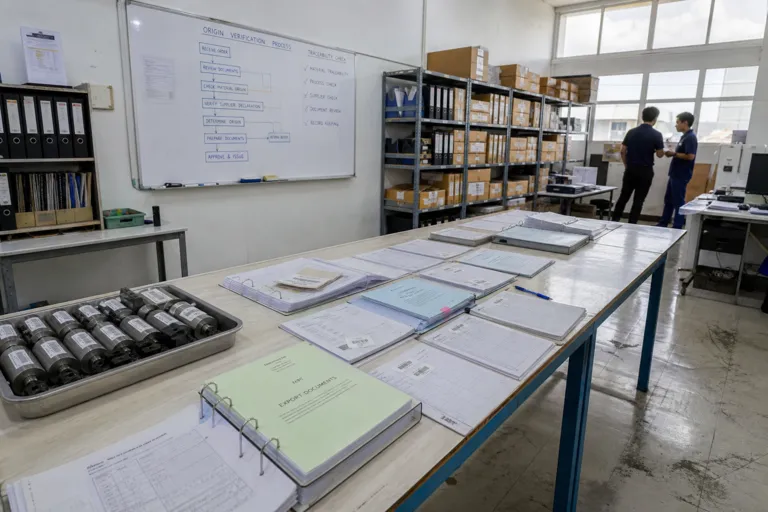
Thai exporters shipping to the US are moving to tighter proof-of-origin controls as Washington increases scrutiny of how goods are made and where inputs come from. The pressure is rising in parallel tracks. One is enforcement against illegal transshipment, including cases where products are routed or lightly processed through third countries before being declared as originating there. The other is broader trade remedy and tariff activity that can change how closely origin documentation is examined, especially for supply chains that rely on Chinese components, technology, or capital and still need to demonstrate substantial processing in Thailand.
A risk-screening lens is already shaping expectations for what US Customs and Border Protection may ask exporters to prove. A White House Office of Trade and Manufacturing Policy report released on August 13, titled The Great Transshipment Scam: Rise, Scope, and Costs, placed Thailand in “Tier 2” alongside Brazil, Indonesia, Malaysia, Turkey, and Vietnam. The report was described as a risk classification for analytical and enforcement purposes, not a finding that Thai exporters have engaged in illegal transshipment. It is also not a new tariff measure. Still, it can inform risk screening, including closer checks of origin documents, production processes, and additional evidence requests when concerns arise.
Where US Enforcement Is Likely to Focus
Exposure is concentrated in a small set of export-heavy industries. An analysis by Associate Professor Dr Aat Pisanwanich of Rangsit University identified eight Thai industrial groups that were responsible for US$52.23 billion in exports to the United States in 2025, equal to 72.33% of Thailand’s total exports to the US. Under assumptions that 10–20% of exports in those sectors could be selected for stricter examination, the analysis estimated that goods worth US$5.2 billion to US$10.4 billion (about 172.359 billion to 344.718 billion baht) could be exposed to additional scrutiny. The analysis stressed these figures represent trade potentially subject to checks, not projected losses, because products can still enter the US if exporters provide complete evidence of origin and manufacturing in Thailand.
Company-level compliance work is converging on the same themes across multiple regulators. Legal briefings noted that electronics and electrical equipment, especially products containing substantial Chinese inputs, have faced origin verification inquiries. Wood furniture, automotive parts, and certain machinery products have also drawn enforcement attention where trade patterns suggest potential transshipment or insufficient processing in Thailand to confer a change in origin. Thai exporters also face parallel signals from the EU: following anti-dumping duties imposed on Chinese-origin products, Thai exporters of e-bikes and electric bicycles have been scrutinized on whether assembly operations in Thailand add sufficient value.
At the policy level, Thai authorities and exporters are adjusting processes as US investigations and negotiations continue. Thailand’s Department of Foreign Trade has created a specialized task force focused on Certificates of Origin, underscoring that paperwork quality is now a frontline control. US tariff probes add to the compliance burden: in October, US Trade Representative Jamieson Greer said structural excess production requires action, and a US investigation spans 16 economies, including Thailand. Separately, Thai reporting on ART talks highlighted that US attention is focused on verifying whether Thai exports incorporate raw materials sourced from countries accused of using forced labour, and to what proportion. In this environment, disciplined documentation and verifiable manufacturing steps are central to protecting market access.
Why are Thai exporters tightening proof-of-origin controls now?
Which Thai exports to the US face the greatest screening risk?
What does “Tier 2” status mean for Thailand in the transshipment report?
How does Thailand rules of origin compliance connect to forced-labour scrutiny?
What product categories have already drawn origin verification attention?