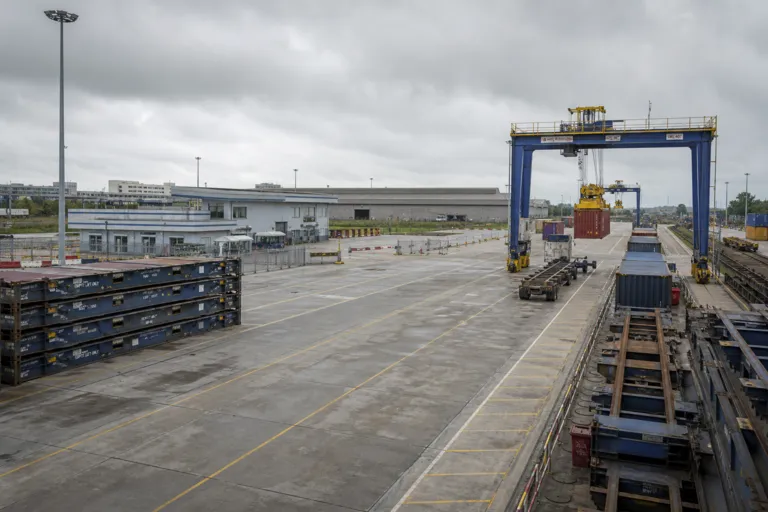
Thailand’s inland container depot (ICD) and dry port direction is increasingly framed as a practical answer to seaport congestion, long truck queues, and the need to move more logistics functions inland. Industry research describes a global pattern where port authorities and logistics providers develop inland freight hubs to decongest port precincts by shifting customs clearance, container storage, and empty depot functions away from coastal terminals. In the same context, ASEAN countries including Thailand are described as developing ICD networks to support a manufacturing base that has expanded with supply-chain diversification from China. This puts Thailand’s inland network discussion inside a broader regional realignment: more factories inland, and a stronger need for predictable links to international shipping networks through seaports.
Thailand’s freight and logistics expansion is also tied to large, named infrastructure programs. One market outlook links government mega-projects to new port, airport, and rail upgrades, with the Eastern Economic Corridor (EEC) anchoring USD 16.8 billion of approved investment in 2024. In that same source, Laem Chabang’s Terminal F build-out is scheduled to add 4 million TEU of capacity by 2027, described as expanding Thailand’s container handling headroom by 40%. The same outlook places Thailand’s logistics costs at 13–14% of GDP, and argues that improved multimodal connectivity can help reduce costs by alleviating road bottlenecks. For inland depots, this kind of capacity and connectivity expansion matters because ICDs depend on reliable port interfaces and consistent linehaul corridors to perform as factory-to-seaport connectors.
Why Inland Depots Matter for Factories and Time-Sensitive Supply Chains
Dry ports and ICDs are often justified by what they can do for industrial clusters, not only what they do for ports. Port economics research notes that several container depots have appeared inland to improve the availability of export containers within manufacturing clusters, citing Thailand among the examples, while also observing that containers in Asia are mainly carried by truck. The same reference explains that inland terminals frequently provide functions that are expensive to keep at the port, including warehousing and empty container depots, and that many such terminals sit close to the port metro periphery, often less than 100 km away, primarily serving seaport facilities. For Thailand’s factory regions, that practical mix—container availability, storage, and repositioning of empties—supports steadier export flows when local cargo imbalances would otherwise complicate equipment availability.
Manufacturing demand adds urgency to inland logistics execution. Thailand approved 1,449 fresh investment projects in 2024, with electronics and automotive taking the largest shares in that cited outlook. The same source notes automotive supply chains’ reliance on time discipline across the region, and separate dry port market research states that automotive supply chains operate on just-in-time component delivery schedules, where customs clearance speed and predictability at an inland port can be critical for production continuity. Taken together, this creates a clear operational reason for Thailand’s inland node build-out: factories want fewer delays between industrial zones and seaports, and inland hubs can bundle services such as clearance, staging, and dispatching into a more predictable handoff.
Thailand’s inland network story also sits inside two market-growth narratives: a national logistics expansion and a global ICD/dry port upswing. Verified Market Research values the Thailand freight and logistics market at USD 64.5 billion in 2024 and projects USD 110.7 billion by 2032, at a 6% CAGR from 2026 to 2032. Globally, estimates differ by publisher, but both point upward: one report values the inland container depot and dry port market at $38.74 billion in 2025 and projects $69.73 billion by 2035 at a 6.1% CAGR from 2026 to 2035; another projects growth from USD 31.01 billion in 2025 to USD 54.49 billion by 2035 at a 5.8% CAGR. For Thailand dry port development, the takeaway is not one single number, but the direction of travel: more investment attention on inland hubs that tie factories, trucks, and rail links to seaports.
What is driving Thailand’s inland container depot and dry port expansion?
Which Thailand project is cited as expanding seaport container capacity?
How do inland depots support factory supply chains, especially automotive?
How is Thailand dry port development connected to broader logistics market growth?