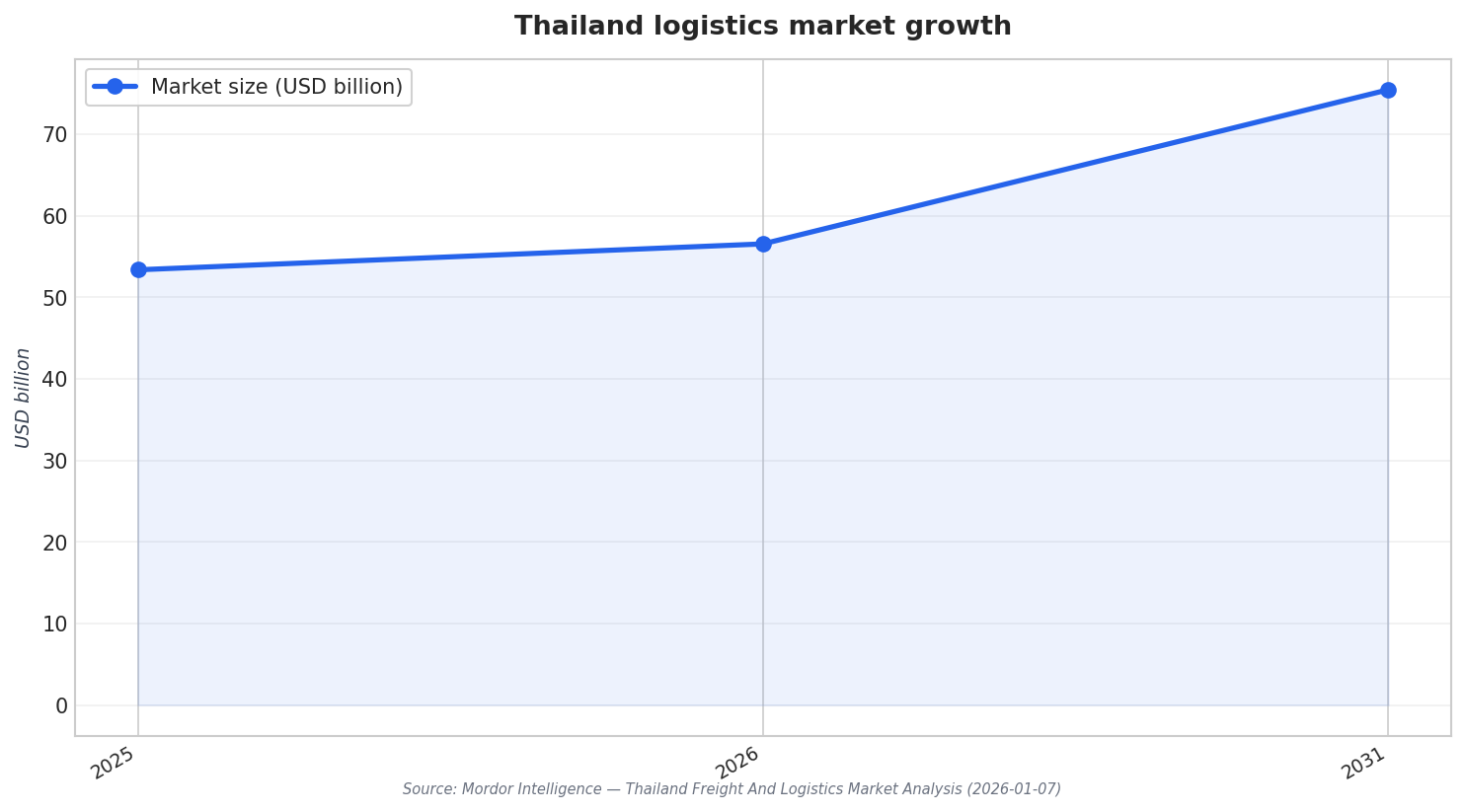
Thailand’s freight and logistics landscape is growing fast, and that expansion is changing how the country thinks about rail capacity and network resilience. Mordor Intelligence forecasts Thailand’s freight and logistics market to grow from USD 53.38 billion in 2025 to USD 56.56 billion in 2026, reaching USD 75.47 billion by 2031 at a 5.95% CAGR over 2026–2031. Within that market, freight transport represented 61.12% of share in 2025, while road freight held 65.05% of 2025 revenue. At the same time, sustainability mandates are described as accelerating modal shifts toward rail and electric truck fleets, creating a policy and commercial backdrop for rail upgrades and more efficient corridor operations.
In parallel, Thailand is positioning itself as a regional gateway as supply chains realign. The Nation Thailand reports foreign investment in Thailand surged 43% in the first four months of 2025, with the Eastern Economic Corridor (EEC) attracting $959 million, or 54% of all foreign direct investment into the country. The same report describes a 115 billion baht ($3.5 billion) infrastructure stimulus package in early 2025 spanning upgrades to roads, logistics hubs, and digital networks. It also highlights Laem Chabang Port handling 9.46 million TEUs in fiscal year 2024, up from 8.67 million in 2023. Those volumes and investment flows shape demand for reliable inland links, where double-tracking is often discussed as a way to reduce conflicts between passenger and freight movements and support more predictable intermodal service.
How Intermodal Projects Tie Rail Upgrades to the Land-Bridge Vision
Thailand’s proposed land-bridge concept is repeatedly framed as an intermodal play rather than a single-mode bet. Mordor Intelligence’s ASEAN inland waterway freight report describes Thailand’s proposed land-bridge as being anchored by dual-gauge rail and river-barge feeders, positioned as an alternative to the Malacca Strait, with feasibility under review. The Nation Thailand report adds that the land bridge project in Chumphon and Ranong provinces aims to reduce transportation costs by 15–20% and cut transit times by four to five days. Taken together, these statements underline why double-tracking matters to the broader ambition: rail needs to connect efficiently into ports, logistics hubs, and feeder services if the land-bridge plan is to function as a dependable, high-throughput corridor.
Regional comparisons also show why Thailand’s rail and intermodal planning is happening in a competitive ASEAN context. The ASEAN road freight transport market was valued at USD 119.43 billion in 2025 and is forecast to reach USD 166.31 billion by 2031, at a 5.69% CAGR (2026–2031), demonstrating how dominant road remains across the bloc even as infrastructure upgrades continue. For cross-border road freight specifically, Mordor Intelligence expects the ASEAN market to reach USD 43.30 billion in 2025 and grow at a 7.07% CAGR to USD 60.90 billion by 2030. The same cross-border report notes Laos leverages its logistics park in Vientiane as a rail-road transshipment node, offering bonded-truck options toward Thailand that shorten total transit time by one day compared with pure-road alternatives. These dynamics increase the strategic value of rail reliability on Thailand-connected corridors.
Port expansion adds another layer to the rail conversation. In Mordor Intelligence’s ASEAN freight and logistics report, Thailand’s Laem Chabang Phase 3 is described as adding 7.1 million TEU by 2026, while new rail spines and inland dry ports are noted as complementing maritime upgrades and shifting some long-haul cargo from congested roads. The same report highlights that new double-stack rail corridors originate from inland container depots to expedite exports from industrial clusters, signaling a wider regional push for higher-capacity rail-linked container flows. Against that backdrop, Thailand rail freight discussions increasingly center on how double-tracking can support smoother port-to-inland connections, reduce bottlenecks, and align with the country’s stated aim of being an indispensable logistics gateway.
How is Thailand rail freight connected to the country’s logistics market growth?
What recent port throughput figure highlights rising demand for inland connections?
What is the stated goal of Thailand’s proposed land-bridge project?
How large is ASEAN’s road freight market compared with rail-focused ambitions?