Thailand’s temperature-controlled supply chain is moving into a new phase, where export requirements and healthcare distribution needs increasingly set the pace. Verified Market Research values the Thailand cold chain logistics market at USD 1.2 Billion in 2024 and projects it will reach USD 2.5 Billion by 2032, with growth at a 9.6% CAGR from 2026 to 2032. The same source frames the market as end-to-end management of temperature-sensitive goods using insulated storage, refrigerated transport, and advanced handling to maintain regulated conditions from origin to consumption. This is especially relevant for exporters shipping fresh produce, frozen foods, meat, dairy, and pharmaceuticals and vaccines that must meet stringent quality and health standards for domestic and international markets.
Other forecasts also underline a steady upward trajectory, even if the baselines differ by methodology. Mordor Intelligence expects the Thailand cold chain logistics market to grow from USD 2.31 billion in 2025 to USD 2.4 billion in 2026, reaching USD 2.89 billion by 2031 at a 3.79% CAGR over 2026–2031. In parallel, Ken Research values the Thailand Cold Chain & Pharma Logistics Market at USD 1.2 billion based on a five-year historical analysis, and attributes expansion to rising demand for temperature-sensitive pharmaceuticals and food products, plus the rapid growth of e-commerce and modern retail. Taken together, these viewpoints point to the same directional signal: more temperature-controlled capacity and tighter compliance are becoming essential for Thailand’s trade-facing supply chains.
Pharmaceutical and Food Exports Are Raising the Bar for Cold Chain Performance
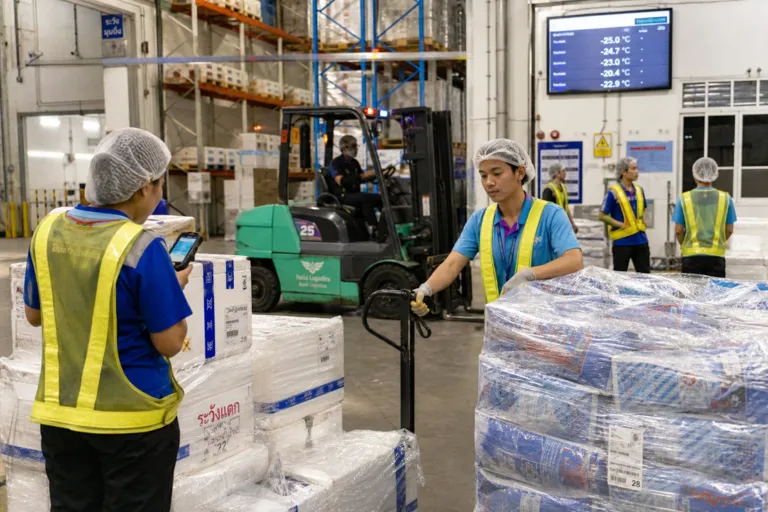
Pharmaceutical distribution is a major driver because it is not just about refrigeration, but also validation and traceability. Verified Market Research highlights real-time monitoring technologies such as IoT sensors and telematics to track temperature and location compliance, while noting that pharmaceutical distribution can require ultra-low temperature storage. Mordor Intelligence quantifies where this is headed: Deep-Frozen/Ultra-Low facilities are forecast to expand at a 5.14% CAGR through 2031, and Pharmaceuticals & Biologics is projected to post a 5.88% CAGR to 2031 in Thailand. At the ASEAN level, Mordor Intelligence also links value-added services growth to pharmaceutical kitting, customs pre-clearance, and IoT-enabled condition reporting, reinforcing how pharma requirements push more specialized, auditable cold chain capabilities.
Food and beverage exports and processor demand remain a parallel engine for investment, particularly in frozen and chilled handling. Mordor Intelligence reports Frozen storage held 52.55% of Thailand’s cold chain market size in 2025, while Meat & Poultry captured 21.74% market share the same year. The ASEAN cold chain report adds trade-facing context, noting Vietnam and Thailand are climbing the value chain in global seafood commerce, which increases the need for blast-freezing, quick-chilling, and controlled-atmosphere shipping during long voyages. Within Thailand, this export push works alongside domestic shifts described by Verified Market Research, including urbanization and modern retail expansion that raise demand for high-value, processed, chilled, and frozen products that require stable temperature control across storage and transport legs.
Infrastructure investment and operational upgrades are also shaping where capacity is built and how efficiently it runs. Mordor Intelligence cites consistent government outlays of THB 2.68 trillion (USD 78 billion) for multimodal infrastructure, and ties momentum in the Eastern Economic Corridor to foreign direct investment that supports temperature-controlled storage and transport assets. It also points to cost relief from a scheduled electricity tariff cut from THB 4.15 (USD 0.12) to THB 3.70 (USD 0.1) per unit, which it says promises THB 100 billion (USD 2.9 billion) in annual savings for warehouse operators and retailers. On the operations side, Mordor Intelligence highlights automation, including PepsiCo’s 16,520-pallet automated storage and retrieval system, and notes consolidation dynamics such as the SCG-JWD merger creating a nationwide, multimodal platform able to bundle storage, transport, and value-added services.
What is the current and forecasted size of Thailand’s cold chain market in major reports?
Which service type leads the market, and what does it suggest about investment priorities?
How is pharmaceutical demand changing requirements in Thailand cold chain logistics?
Which temperature segment and food application are most prominent in Thailand’s cold chain market?
What policy and cost factors are reported to support cold chain investment in Thailand?