Thailand’s gem and jewellery trade entered 2026 on a wave of safe-haven buying that pushed gold shipments sharply higher. In January 2026, exports excluding gold totalled US$1,808.12 million, up 4.26% year on year, according to the Gem and Jewellery Institute of Thailand (GIT). When gold is included, total export value reached US$4,566.20 million, a 57.34% jump. GIT linked the rebound to New Year and Lunar New Year spending, alongside geopolitical shifts that encouraged investors to seek shelter in bullion.
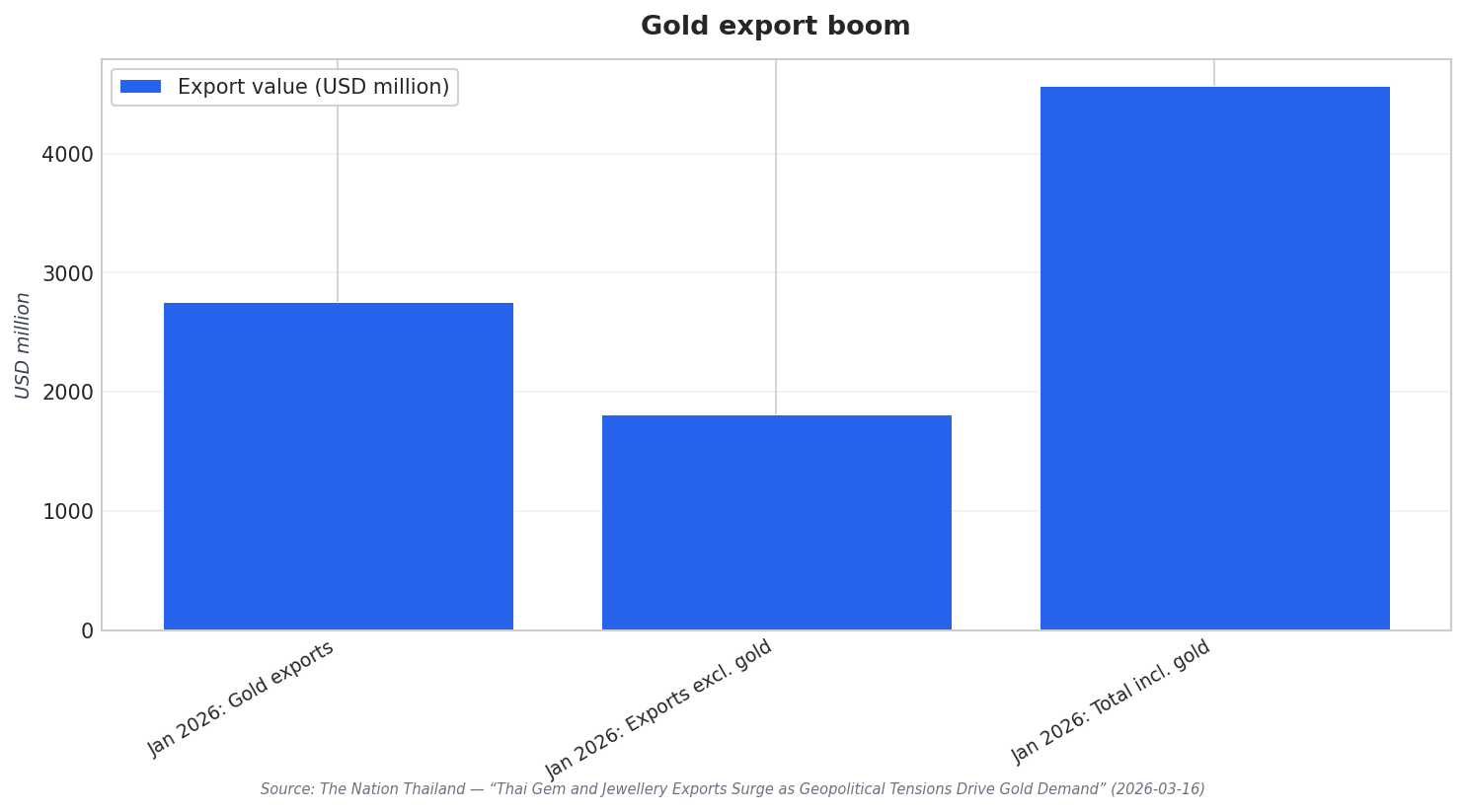
Gold dominated the January story. Gold exports surged 136.16% to US$2,758.08 million as investors positioned for instability, with analysts citing conflict between Israel and Iran and broader geopolitical tensions. The export map also shifted across hubs. Shipments to the UAE rose 254.58%, while Switzerland and Japan increased 155.38% and 70.70%, respectively. Britain was up 12.12% and Hong Kong rose 51.65%. The United States moved the other way, down 36.55%, which GIT attributed to earlier stockpiling by importers and a temporary pause in new orders.
Where the Boom Is Coming From—and What It Masks
Late 2025 data showed how quickly the Thailand gem and jewelry export industry can look stronger on paper when bullion trades surge. In the first nine months of 2025, gem and jewellery exports totalled 719.35 billion baht, up 62.42% year on year. Yet industry sources warned that much of the headline growth was driven by unwrought gold, which accounted for over half of total gem and jewellery exports during the period. Unwrought gold exports reached 108,682 kilograms worth 364.55 billion baht, up 89.36% from 192.51 billion baht in 2024, while finished gold jewellery exports were 79.79 billion baht, only 8.25% higher than 73.71 billion baht a year earlier.
Momentum also appeared in non-gold categories, though performance varied month to month. In November, exports excluding gold jumped 76.7% year on year to US$1.46 billion, extending a 13-month growth streak. But in that same month, gold exports fell 51.1%, with analysts pointing to record-high prices and volatility that discouraged speculative trading and slowed physical movement. Market shifts were visible too: the UAE was up 90.4%, while the US slipped 0.3%. GIT also flagged currency pressure, noting that a strengthening baht could erode price competitiveness against regional neighbours.
Early 2026 underscored why GIT is preparing exporters for a volatile year. After January’s gains, February exports excluding gold fell 29.32% year on year to US$1,624.04 million, even as gold remained strong on safe-haven demand and higher global prices. GIT pointed to escalating Middle East conflict, oil-market tightness, and the closure of the Strait of Hormuz, described as a route for about 20% of global oil exports, as risks that could deepen a global slowdown. In February, exports rose to several markets, including the UAE (up 189.27%) and Switzerland (up 138.85%), while India fell 39.50% and the US dropped 26.57% as earlier stockpiling continued to weigh on new orders.
What did Thailand’s gem and jewellery exports total in January 2026?
How much did Thailand’s gold exports rise in January 2026?
Why do some analysts say the export boom can be misleading?
What changed in February 2026 for non-gold exports?
How is the Thailand gem and jewelry export industry shifting across markets?