Thailand’s push toward electric mobility is now forcing a second question: what happens to batteries when vehicles retire. In 2025, BEV registrations surged 80% to 120,301 units, taking market penetration to 19.4%, according to Maverick consulting group. Another data point underlines the scale-up pressure. REGlobal, citing an Asian Development Bank assessment, says EV registrations in 2024 stood at 700,000, equal to 1.5% of total vehicle stock, and that BEVs have posted a 143.6% CAGR since 2020. As volumes rise, Thailand’s battery system has to mature beyond assembly into lifecycle control, including safe collection, recycling, and second-life use.
Policy is beginning to harden around circularity. Ken Research reports that in 2023 the Thai government implemented an “Electric Vehicle Development Plan” with regulations mandating recycling of EV batteries, aiming to ensure at least 70% of battery materials are recycled by 2025. That mandate matters because the recycling challenge is not only environmental. It is also about securing supply chains for materials that REGlobal flags as recoverable through robust end-of-life management, including lithium, cobalt, and nickel. Nexdigm also notes that Thailand’s national EV roadmap is tied to incentives that promote battery production and local component sourcing, while also promoting battery recycling initiatives.
From Regulation to Ecosystem: Who Is Building the Loop
Market signals are mixed, which suggests the ecosystem is still forming. Ken Research publishes two different Thailand valuations: one page frames the Thailand EV Battery Recycling & Second-Life Market at USD 1.2 billion, while another puts the Thailand EV Battery Recycling Market at approximately USD 4 million, each described as based on five-year analysis. What is consistent is the direction of travel and the breadth of actors. Ken Research lists participants spanning Thai and global names, including Siam Cement Group, PTT Public Company Limited, Energy Absolute (Amita Technology Thailand), and firms such as TES-AMM, Umicore, Veolia, LG Chem, Samsung SDI, CATL, BYD, Panasonic, and Tesla. It also highlights Bangkok, Chonburi, and Nakhon Ratchasima as active locations, with Bangkok described as a hub for EV manufacturing and innovation.
Industry partnerships are increasingly treating battery end-of-life as a practical constraint, not a footnote. Marqstats points to “battery and EV lifecycle management” becoming a policy focus, citing an MOU between TAI and GWM that includes EV battery end-of-life management. The same source notes NV Gotion’s (a PTT Group and Gotion High-tech JV) MOU with PLANET for EV battery and energy storage partnerships, signaling the start of a domestic battery ecosystem beyond vehicle assembly. Marqstats also reports electric mobility registrations of 51,412 units in Jan–Feb 2026, up 52.7% year-on-year, with passenger EVs up 167.4% year-on-year. Those kinds of growth rates can quickly turn end-of-life handling into an operational bottleneck without standards and capacity.
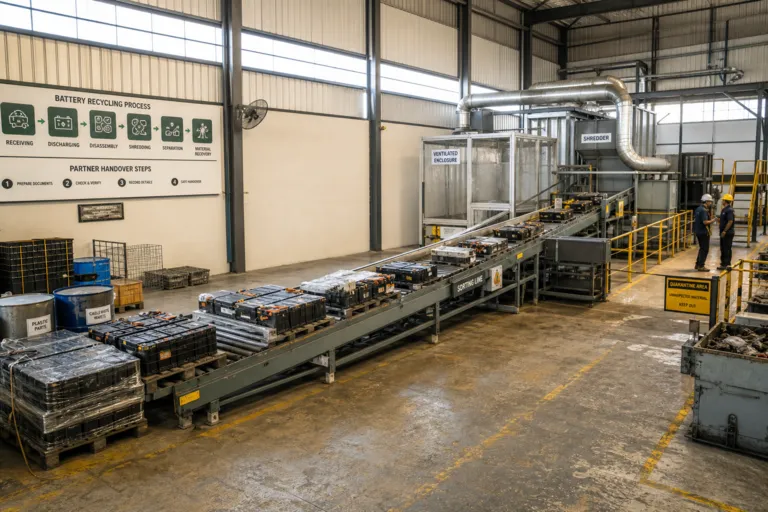
Viewed together, the building blocks of Thailand EV battery recycling look like an ecosystem-in-progress: a recycling mandate targeting 70% material recovery by 2025, rising EV adoption, and a widening network of corporate players and MOUs that connect vehicles, batteries, and energy storage. Ken Research also describes segmentation by battery type, noting lithium-ion dominance, and by end-user, with automotive leading. The next step is execution at scale: clear rules for safe disposal, incentives aligned to circular outcomes, and industrial capability that keeps pace with accelerating registrations. Thailand’s EV trajectory is moving fast; closing the loop has to move faster.
What recycling target has Thailand set for EV battery materials?
How fast is Thailand’s EV market growing, and why does that matter for battery end-of-life?
Which materials are highlighted as valuable to recover through battery recycling in Thailand?
What partnerships signal that battery lifecycle management is becoming a core focus?
How is Thailand’s EV battery recycling ecosystem described in market coverage?