
Thailand’s dialysis market is being pulled toward community access as chronic kidney disease (CKD) remains a key driver of dialysis demand across Asia Pacific. Regional research frames CKD growth around diabetes and hypertension, and highlights system gaps that can delay intervention until patients are in advanced renal failure. The World Health Organization is cited as estimating hypertension affects more than 1.1 billion people globally, with Southeast Asia seeing higher prevalence over the past decade. In that context, treatment models that reach patients earlier and closer to where they live become more important, especially when late diagnosis and fragmented primary care are part of the problem.
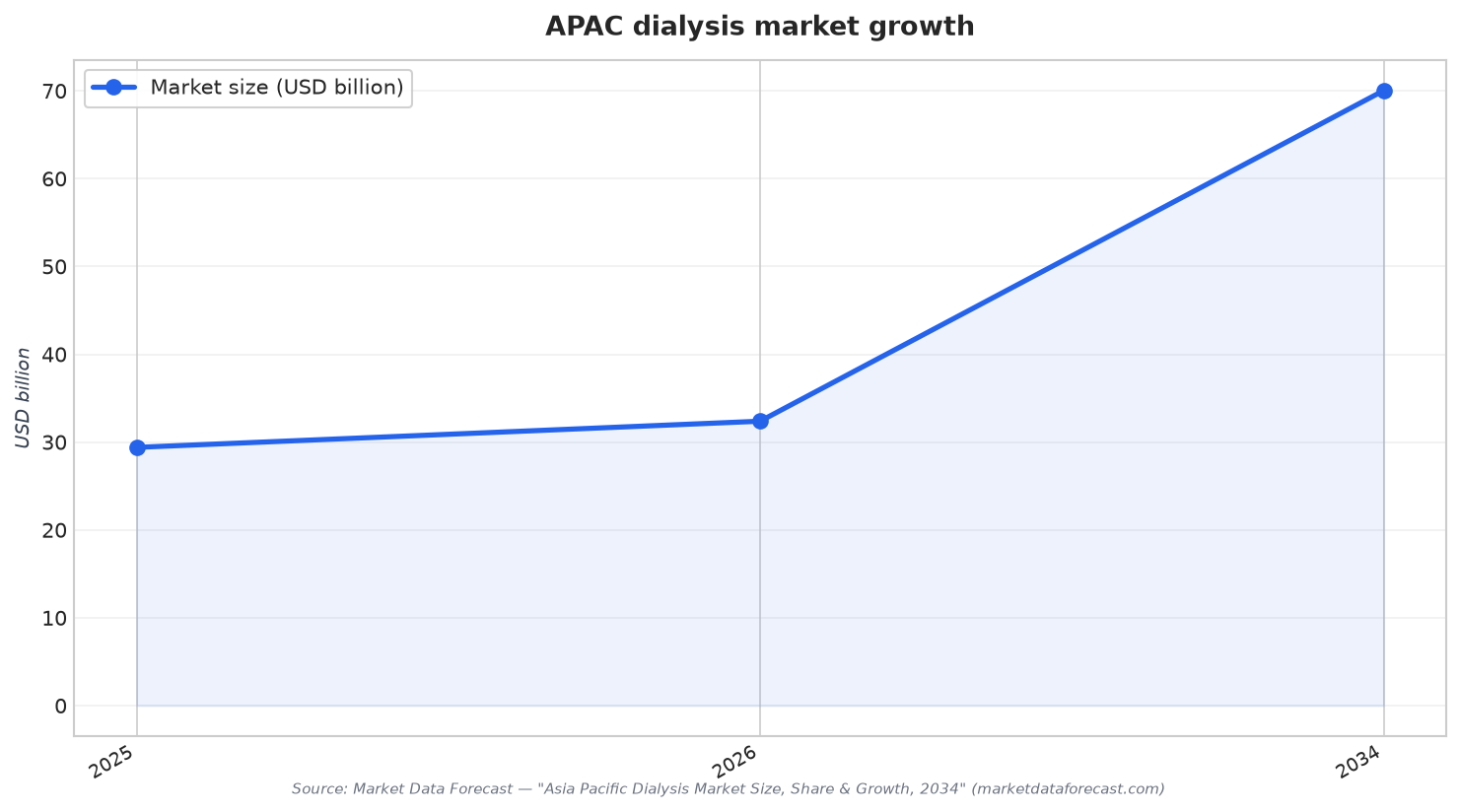
Regional market signals point to expanding capacity, which supports a narrative of dialysis moving beyond centralized sites. The Asia Pacific dialysis market was valued at USD 29.40 billion in 2025 and is anticipated to reach USD 32.38 billion in 2026, with a forecast of USD 70.02 billion by 2034 at a 10.12% CAGR (2026–2034). In parallel, the Asia Pacific dialysis equipment market was valued at USD 4.51 billion in 2025, is estimated at USD 4.96 billion in 2026, and is projected to reach USD 10.56 billion by 2034 at a 9.9% CAGR (2026–2034). These trajectories matter for Thailand because they indicate a region-wide push for more machines, more consumables, and more delivery sites that can support care outside major urban hospitals.
Community Delivery, Home Modalities, and Smarter Monitoring
Product and modality trends also align with bringing treatment closer to patients. Asia Pacific equipment reporting describes increasing adoption of home-based and peritoneal dialysis solutions, plus rising integration of IoT-enabled and smart dialysis machines for remote monitoring and personalized care. It also notes that in-centre dialysis dominated by end user in 2025, while home care dialysis is projected to grow due to convenience, flexibility, and technological advances. Separately, a global dialysis care products report states that adoption of peritoneal dialysis in home care settings has surged by approximately 4.3% annually. For Thailand, these trends support expansion paths that combine local center networks with home-based options, especially where travel time and appointment bottlenecks can shape access.
Thailand is explicitly referenced in a broader Southeast Asian buildout narrative. A report on dialysis disposable devices states that Southeast Asian nations including Thailand and Vietnam are establishing dialysis center networks with government support. While it does not quantify Thailand’s network size, it does connect the country to a policy-backed effort to widen access. That same report frames government spending as a catalyst in emerging markets, illustrating the type of public investment that can expand dialysis accessibility in underserved populations. Taken together, the implication for Thailand is that service growth is not only a private-provider story; it can be driven by reimbursement and infrastructure programs that make community sites viable.
Thailand’s outlook also sits within a global market that is expanding as CKD prevalence rises. One global kidney dialysis market report states the market will grow from USD 90.88 billion in 2025 to USD 97.98 billion in 2026 at a 7.8% CAGR. Another global analysis estimates the dialysis market at USD 99.5 billion in 2025 and expects 5.5% CAGR between 2026 and 2035, while projecting Asia Pacific’s share to rise from 30.0% in 2025 to 36.0% by 2035. These figures do not measure Thailand directly, but they reinforce why Thailand’s dialysis providers and planners are looking at distributed care models: regional share is rising, and demand growth is being met with a mix of expanded centers, home modalities, and technology-enabled monitoring.
Why is dialysis expanding into communities in Thailand?
What do Asia-Pacific market figures suggest about dialysis growth around Thailand?
Which dialysis modalities are linked to care closer to patients?
Is home care expected to grow even if in-centre dialysis is still dominant?
How does the Thailand dialysis market fit into wider global momentum?