

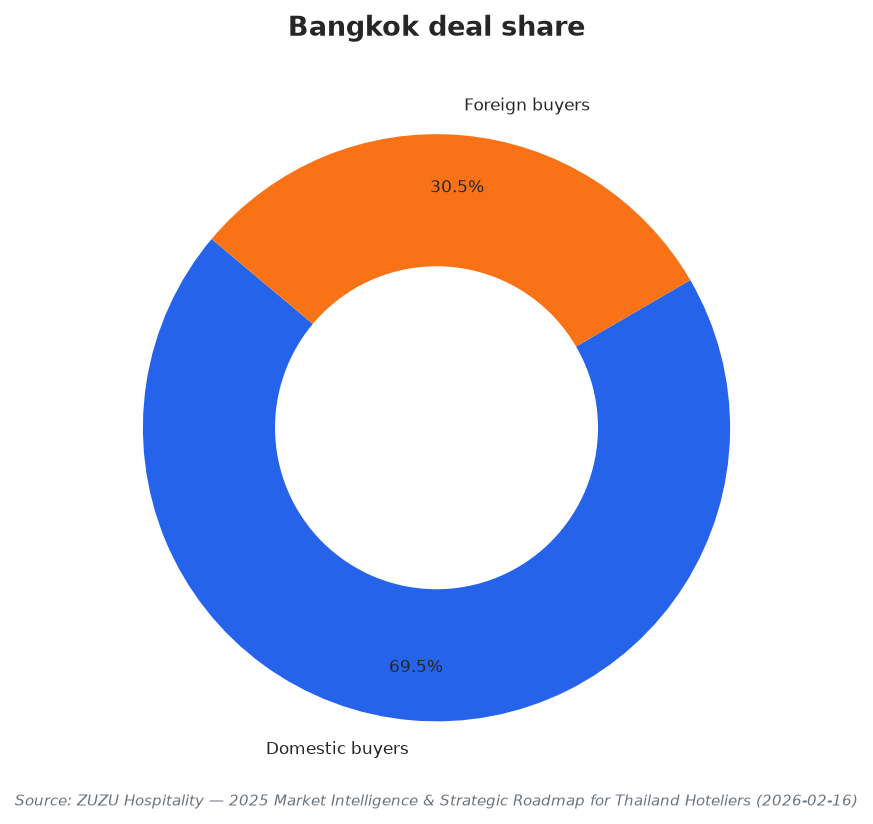
Thailand’s hotel transaction scene accelerated in 2025, pulling attention from foreign buyers even as operators brace for tougher competition in Bangkok and Phuket. Bay Street Hospitality reported a record THB 26.4 billion (about USD 845 million) across 18 single-asset deals in 2025, describing it as the highest ever recorded and nearly double the 10-year historical average. A separate market view from Zuzu Hospitality cited USD 301 million (THB 9.8 billion) in hotel investment volume in the first half of 2025 and projected full-year volume to exceed USD 650 million (over THB 20 billion). In that same Zuzu dataset, Bangkok absorbed the majority of the capital, and domestic buyers represented 69.5% of total transaction volume.
Demand fundamentals look more cautious than the deal headlines suggest, which matters for underwriting in the Thailand hotel investment market. Bay Street Hospitality said Thailand welcomed 32.97 million international arrivals in 2025, down 7.2% year-on-year and reaching only 83% of the 2019 peak. The same source highlighted a major source-market shock: Chinese arrivals fell 34% year-on-year to 4.47 million. Offsetting flows were meaningful but not complete, with India up 16.8% to 2.49 million, Russia up 8.8% to 1.90 million, and Malaysia the largest source market at 4.52 million, although down 8.7% year-on-year. On performance signals, Bangkok occupancy fell to 75.1% in 1H 2025, down 3.7 percentage points year-on-year, while Phuket ADR held at THB 5,788, up 5.6% year-on-year.
Upscale Supply Builds a Sharper Battleground in Bangkok and Phuket
New luxury and upscale openings are raising the competitive bar, particularly in the two markets that dominate international attention. Money & Banking Magazine, citing hotel market research and commentary from Knight Frank Thailand’s Director of Research and Consulting, said Bangkok and Phuket are entering a more intense phase of competition as luxury and upscale hotels gradually open and “set new standards” in product and guest experience. In Phuket, the report stated there were 47,195 rooms, with about 58% in luxury and upscale segments. It also said new projects between 2569 and 2571 are projected to account for as much as 89% of high-end hotels as well. The same article described expansion beyond Patong into areas such as Bang Tao, Kata, Chalong, Rawai, and Nai Harn, signaling where incremental supply and land-positioning strategies may cluster.
This supply pressure is already changing how owners defend rate and how investors think about value creation. Zuzu Hospitality emphasized renovation tactics that avoid full structural work, pointing instead to “soft goods” upgrades such as carpets, curtains, linens, and 55-inch Smart TVs with streaming capability to compete with modern supply. It also cited major operator spend: Anantara Siam Bangkok investing USD 50 million in phased renovations, and Centara Hotels & Resorts announcing a THB 15 billion investment program over three years. Meanwhile, Bay Street Hospitality noted JLL forecasts a reversion in Thailand’s hotel transaction market to THB 13 billion in 2026 as speculative capital exits. Together, these signals point to a market where asset quality, renovation readiness, and micro-location selection matter more than ever.
Foreign buyer interest also runs into structuring realities and a shifting domestic property backdrop. Nomad Lawyer said Thailand’s Foreign Business Act restricts non-Thai entities from owning land, complicating acquisition structures, and it reported that formal sales listings for five-star hotels declined 60% since 2024, with prices climbing 15–25% above historical valuations when premium properties appear. Separately, Thailand Hotel News described weakening conditions in the broader property market, noting ownership transfers fell to their lowest levels in about seven years during 2025 and that unsold luxury condominium inventory has accumulated in several locations. For cross-border capital, Bay Street Hospitality highlighted tax context in the Singapore–Thailand DTA, listing 10% withholding tax on dividends, 15% on interest, and 5–10% on royalties. The result is a 2026 environment where foreign capital can still find opportunities, but success depends on disciplined pricing, realistic demand assumptions, and a plan for competing against newer upscale supply.
What signals show momentum in Thailand’s hotel investment market in 2025?
How did international arrivals affect hotel demand in 2025?
What does the new upscale supply mean for Bangkok and Phuket competition?
What performance indicators were reported for Bangkok and Phuket hotels?
What could change transaction activity in 2026?