
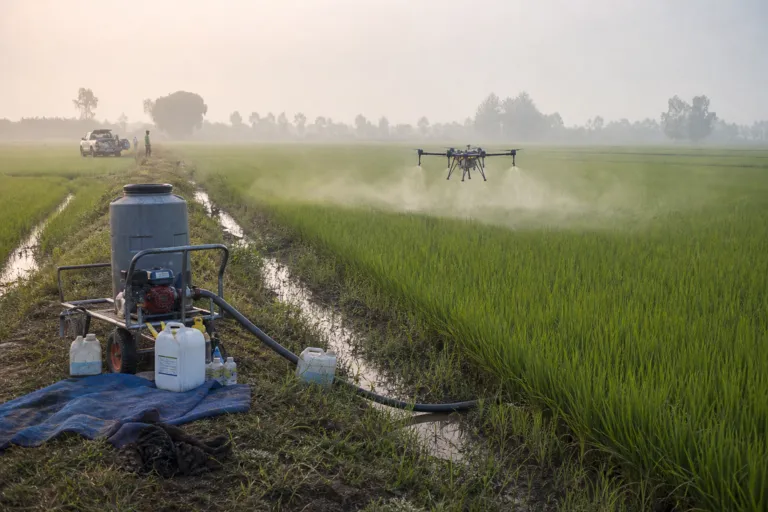
Thailand’s agricultural drone momentum is increasingly tied to the realities of farm labour. In the country and across Southeast Asia, labour shortages are pushing growers toward mechanised and precision spraying rather than treating new equipment as optional. This shift is also linked to the pressure of an ageing agricultural workforce and declining interest among younger generations, which is forcing farmers to rely more on machinery to sustain operations. Drones are part of that change. CLAAS highlighted that drones have helped farmers become more familiar with technology-driven approaches, which can lower resistance to wider mechanisation and digitalisation.
Adoption signals are visible in usage data. Drones were used on 30% of Thailand’s farmland in 2023, up from almost none in 2019, mainly for spraying pesticides and spreading fertilizers. That pattern fits the broader regional trend described in a Southeast Asia agricultural sprayers study, which notes a widening equipment mix that ranges from manual backpack units for small farms to drone fleets and tractor-mounted systems for large estates. The same report frames mechanised and precision spraying as a direct response to labour scarcity, helping sustain spending even when commodity cycles weaken.
Market Signals: Investment, Policy Support, and Service Networks
Industry reports also point to expanding commercial opportunity around drones, including agriculture-focused applications. IMARC Group estimates Thailand’s overall drones market reached USD 192.81 million in 2024 and projects it will reach USD 470.13 million by 2033, implying a 10.41% CAGR during 2025–2033. Within that broader market shift, the same source describes rapid adoption in agriculture for crop health monitoring, soil mapping, and precision spraying in rice, rubber, and palm oil plantations. It also links momentum to the “Thailand 4.0” initiative and notes that the Civil Aviation Authority of Thailand (CAAT) is streamlining drone registration and flight approval processes, lowering barriers for commercial operators.
On the agriculture side specifically, Ken Research values the Thailand drone tech for agriculture market at USD 150 million based on a five-year historical analysis. It says growth is driven by precision agriculture and cites government action in 2023: Thailand implemented a policy providing subsidies for drone purchases and allocated approximately USD 20 million for the program. Ken Research also identifies Bangkok, Chiang Mai, and Nakhon Ratchasima as key locations for market activity, and says multi-rotor drones dominate because they are versatile for crop monitoring and precision spraying, with smallholder farmers as a leading end-user group.
Beyond equipment sales, service delivery is becoming part of the adoption story. Mordor Intelligence describes a regional shift from individual purchases toward outsourced spraying and drone-service models, which can help farmers access drones without the upfront cost of ownership. In Thailand, this service-layer buildout includes XAG Co., Ltd and Chia Tai opening a service center in May 2025. For context on the wider equipment ecosystem around spraying, Mordor Intelligence estimates the Southeast Asia agricultural sprayers market was USD 315 million in 2025 and projects it will reach USD 470.1 million by 2031; it also forecasts unmanned aerial vehicle sprayers will expand at a 14.2% CAGR through 2031, underscoring why drone spraying is drawing attention as labour availability declines.
How fast is drone use expanding on Thailand’s farms?
What is the estimated size of the Thailand agricultural drone market in available reports?
What policy support has Thailand provided for agricultural drone adoption?
Why are spraying drones gaining traction in Thailand and the region?
Which drone types and users are leading in Thailand’s farm-drone segment?