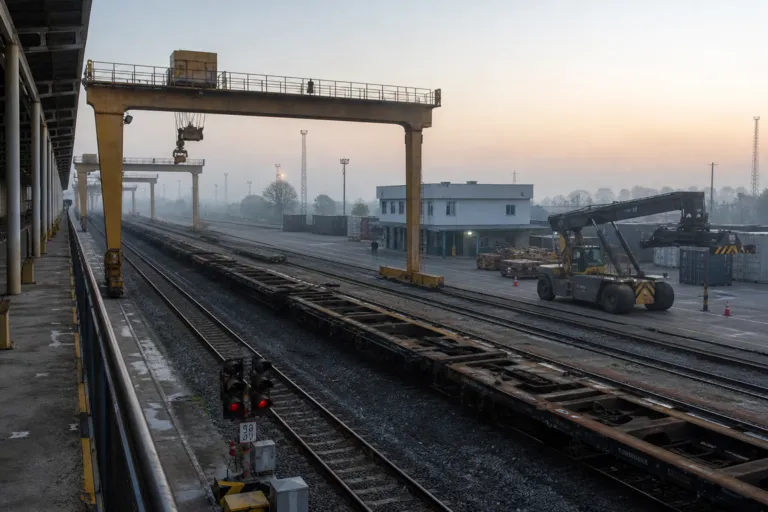
Thailand has begun a trial freight rail service between Laem Chabang Port in Chonburi and Nong Khai, testing a public-private operating model under the Railway Transport Act B.E. 2568 (2025). Deputy Prime Minister and Transport Minister Phiphat Ratchakitprakarn presided over the inaugural run at Container Yard Side C (Port C), Laem Chabang Port, in Sriracha district. The corridor is framed as a way to shift more cargo from roads to rail, reduce logistics costs, and strengthen trade links through Laos into southern China. The test also reflects Thailand’s broader ambition to function as an ASEAN transport and logistics hub.
The first return journey ran at full haulage capacity. It used 24 flat waggons carrying 48 TEUs of natural rubber supplied by Sri Trang Logistics Company Limited, with the locomotive provided by TPI Polene Public Company Limited. The project brings together the Office of Transport and Traffic Policy and Planning, the Department of Rail Transport, the State Railway of Thailand (SRT), the Federation of Thai Industries, the Thai Chamber of Commerce, the Board of Trade of Thailand, and private partners. SRT governor Anan Phonimdang said the run is designed to gather operational data on fuel use, track-access charges, locomotive fees, and cargo-handling costs across the supply chain.
Why This Corridor Matters for Costs and Capacity
Cost reduction is a central target of the trial. The Transport Ministry estimates that using existing diesel locomotives could reduce logistics costs by about 10%, while a longer-term switch to electric locomotives could lift savings to 20–30%. The ministry also wants rail to become Thailand’s main national freight spine, with road transport used largely to feed goods from rail terminals to regional destinations. Fleet constraints remain a factor: the SRT has about 120 working locomotives from a fleet of 200, with around 60 more than 40 years old. Plans call for procuring 50 to 60 replacement locomotives, with expansion expected to rely heavily on private-sector cooperation.
Nong Khai’s strategic role sits inside a broader rail and port modernization story. Research on Thailand’s rail network reports that the double-track system has expanded to over 3,150 kilometers, increasing line capacity from 54 trains per day to 150–200 trains per day, and cutting crossing wait times by an average of 30–50%. Even so, rail freight’s modal share is still about 7–9%, below a National Strategic Goal of 15%, with gaps in seamless connectivity at major freight terminals cited as a key constraint. In that context, a stronger Nong Khai logistics hub narrative ties closely to making cross-border rail more usable and commercially predictable.
The Laem Chabang end of the corridor is also scaling up. Laem Chabang Port currently handles approximately 11 million TEUs annually, and Phase 3 expansion is expected to increase capacity to 18 million TEUs. Policy aims cited in market analysis also include lifting the rail share of port-connected cargo from 7% to 30%. On the cross-border side, one study finds the Thailand–Laos–China route has seen an average annual increase of 25% in freight volume through the Nong Khai border since 2022. It also suggests that standardizing signaling to ETCS Level 1 could raise cross-border freight speeds from 40 km/h to 70–80 km/h and reduce cross-border logistics costs by 15–20% compared with road transport.
What happened in the Laem Chabang–Nong Khai freight rail trial?
How much could rail cut logistics costs on this route?
How does the project support a Nong Khai-focused logistics hub strategy?
What are the key rail network constraints and upgrades mentioned in the sources?
What capacity figures are cited for Laem Chabang Port?