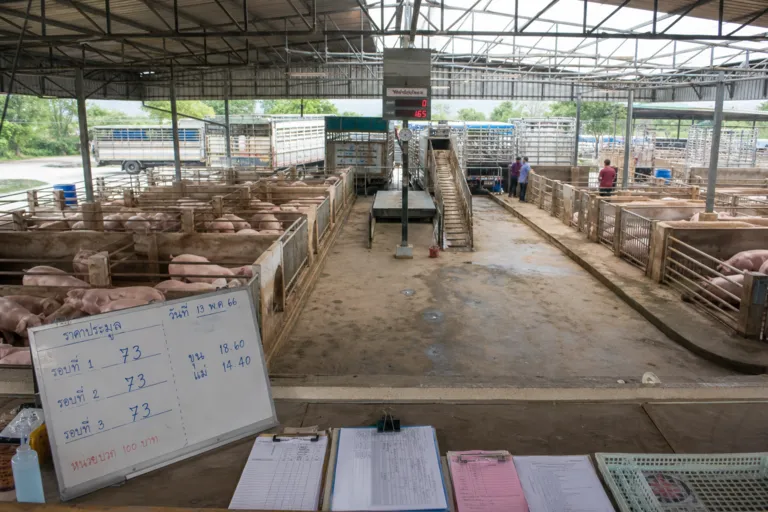
Thailand’s pork producers are entering 2026 with a familiar problem: too many pigs chasing soft demand. Industry projections cited by the Swine Raisers Association of Thailand (SRAT) point to pork output of about 24.29 million head in 2026, up from 23.49 million head in 2025. The result has been heavy pressure on farmgate economics and broader supply chains tied to feed, slaughtering, and rural jobs. SRAT president Sitthiphan Thanakiatpinyo has warned that unchecked expansion by large farms, alongside periodic shocks such as disease outbreaks and illegal imports, can destabilize prices across the system.
Pricing signals have turned sharply negative. KGI Securities reported that domestic swine prices dropped 14% over a two-week period to Bt55.5/kg, with the fall linked to persistent oversupply. The report also pointed to aggressive promotions to clear inventories, including a Bt100 per 2 kg offer. Against that backdrop, SRAT outlined a supply-management plan aimed at reducing piglet availability by producing approximately 300,000 roasted suckling pigs over the next six months, or about 50,000 pigs per month. Even then, KGI cautioned that any impact from reduced supply could take 3–6 months to show up.
Malaysia Market Access Offers Relief, but Not a Cure
Exports are becoming central to stabilizing the Thailand pork industry, and Malaysia has emerged as the most immediate outlet. Following negotiations involving Thailand’s Department of Livestock Development and Malaysian authorities, Malaysia issued approval letters allowing four Thai operators to export chilled and frozen pork and pork cuts. The four approved facilities named in market reporting were VC Meat Processing, Betagro Agro Industry, CPF (Thailand) Public Company’s Krabi Pig Slaughterhouse, and CPF Kanchanaburi Pig Slaughterhouse. Shipments are expected to begin in 2026, with exports projected at around Bt4 billion in value, a figure repeatedly cited by industry and media reporting.
Still, the new channel has clear limits. KGI estimated that the approved export volume represents only around 2% of Thailand’s total pork production, suggesting that Malaysia alone cannot quickly rebalance the domestic market. Malaysian officials have also stressed that imports are not intended to undermine domestic producers, highlighting that both sides are approaching the arrangement carefully. Thai industry leaders, meanwhile, continue to urge closer coordination among large and small farms to avoid repeating oversupply cycles. Regulators are also tightening food-safety enforcement and cracking down on illegal feed additives to protect confidence in Thai pork at home and abroad.
Concerns about imports add another layer of uncertainty. Al Jazeera reported that Thai producers fear potential duty-free access for US pork as part of trade discussions, citing Washington’s wish list of goods it wants to enter Thailand duty-free and the White House’s call for Thailand to “expedite” access for US meat and poultry. Farmers interviewed also referenced worries about competition from cheaper, subsidised US pork and noted that ractopamine is banned in Thailand. The same reporting described how the sector has faced pressures before, including illegal pork imports from China and Vietnam. For producers already battling a glut, the mix of oversupply, enforcement challenges, and shifting trade policy keeps margins fragile even as Malaysia provides a partial outlet.
What is driving oversupply pressure in Thailand’s pig sector in 2026?
How far did Thai swine prices fall in the latest reported drop?
Which Thai facilities were approved to export chilled and frozen pork to Malaysia?
How much relief can Malaysia-bound exports provide to the Thailand pork industry?
What supply-cut step did the Swine Raisers Association of Thailand propose?