Thailand’s film and content industry is scaling beyond its home market through a mix of export-friendly genres, platform distribution, and a government-led soft-power model. A 2026 analysis describes the Ministry of Culture and the Department of International Trade Promotion (DITP) as shifting from passive regulation to active promotion of cultural influence. The domestic pipeline is also clearly active: Thai movies released in 2023 totaled 58 titles, while 10% of Thai films produced in 2023 were released exclusively on streaming platforms. On the distribution side, streaming overtook 60% of film distribution, alongside THB 25 billion in total digital entertainment revenue in the same research set.
Genre strategy is a major part of how Thai stories travel. Horror is consistently prominent in the sources, accounting for 40% of Thai films produced annually in one dataset and 45% of local film releases in another. Thai horror films also dominated the domestic market in 2023 by contributing 28% of total box office revenue, and they saw a 25% higher audience retention rate on VOD compared to other genres. Signature hits and export edits show how local IP adapts abroad: Pee Mak remains the highest-grossing Thai film of all time with 1 billion THB revenue, while Thai films exported to China are usually edited to remove 10-15% of content for censorship compliance.
Soft Power, Y-Series, and Global Platform Reach
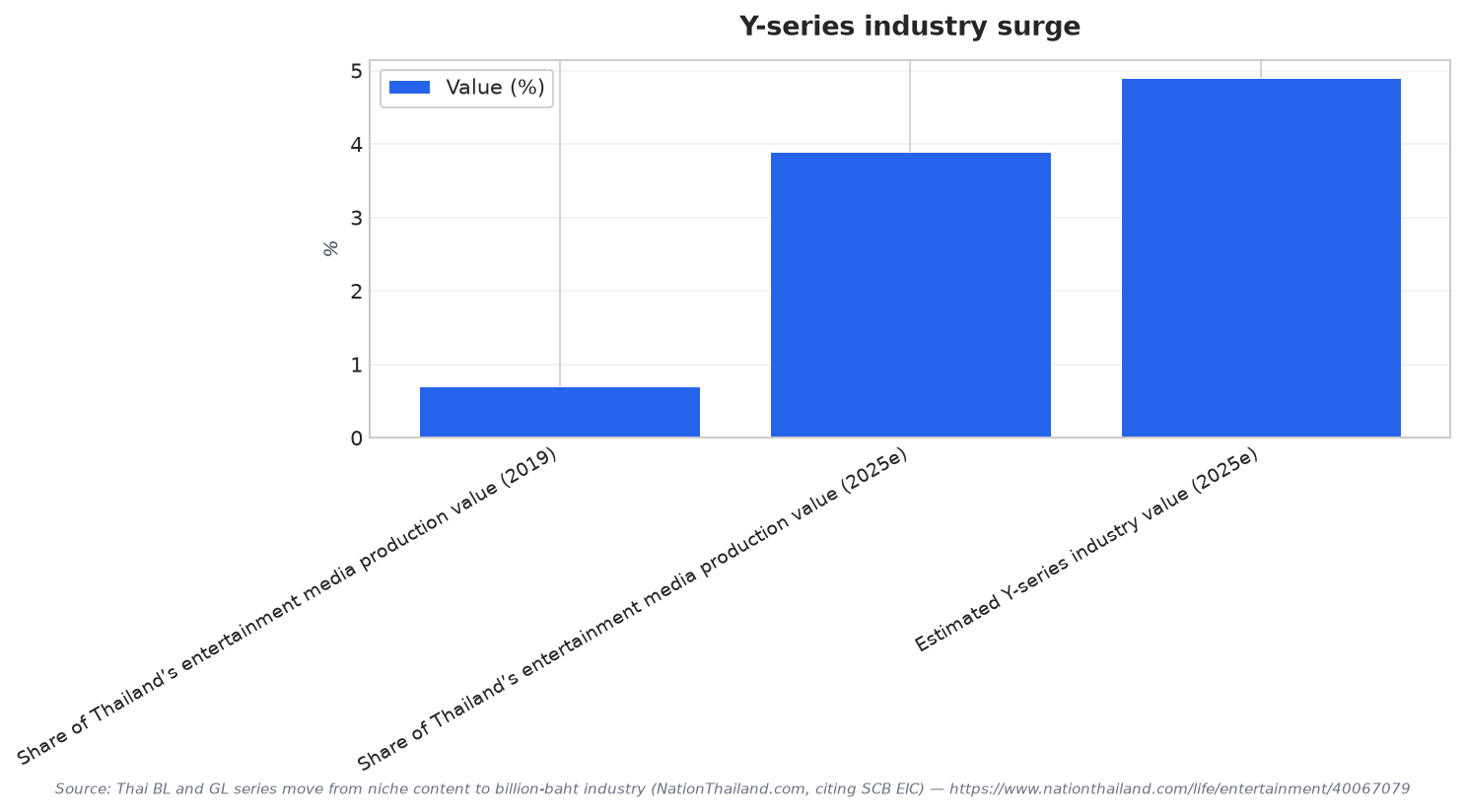
BL and GL content has become one of Thailand’s clearest soft-power levers, supported by both market momentum and official promotion. SCB EIC estimates the Y-series and gender-diversity content industry will be worth more than 4.9 billion baht in 2025, with average annual growth of 17%, and its share of Thailand’s total entertainment media production value is expected to rise to 3.9% from 0.7% in 2019. In 2024, Thailand accounted for more than 55% of BL series production in Asia and around 60% of GL series production in the region. The same ecosystem is amplified by global services named in the sources, including Netflix, WeTV, iQIYI, YouTube, and GagaOOLala.
Government trade activity is also explicitly tied to pushing Thai content outward. One report says DITP launched six dedicated activities in 2026 to propel Thai BL series into international markets, including matchmaking trade meetings at Hong Kong Filmart 2026 (March 17-20), promotion events in Sydney, and trade delegations to Brazil, Mexico, the UK, Spain, and Taiwan in June 2026, plus a Thai Film Festival in Vietnam in July 2026. That outward push sits alongside measurable global consumption signals: Thai BL series generate over 1 billion views on global streaming platforms, and fan-meeting events for Thai film casts can generate up to 10 million THB in ticket sales per event.
Inbound production and film tourism add another global layer, turning Thailand into both a set and a brand. Thailand hosted 466 foreign film productions in 2023, with 35% of all foreign filming taking place in Bangkok; European productions account for 20% of foreign filming permits issued, and the United States is identified as the primary source of foreign film revenue for Thailand. Speed also matters: foreign film crews can apply for a filming permit within 3-5 working days. Tourism spillovers are quantified in several examples, including film tourism contributing an estimated 10% of international arrivals in Krabi and Phuket, The Beach (2000) increasing tourism to Maya Bay by 400% in subsequent years, and Lost in Thailand (2012) being linked to a 25% increase in Chinese tourists to Chiang Mai.
What is driving global growth in Thailand’s film and content industry?
How large is Thailand’s Y-series (BL/GL) business expected to be?
How important is horror to Thailand’s film output and performance?
How active is Thailand as a location for foreign productions?
What evidence links Thai films and series to tourism demand?