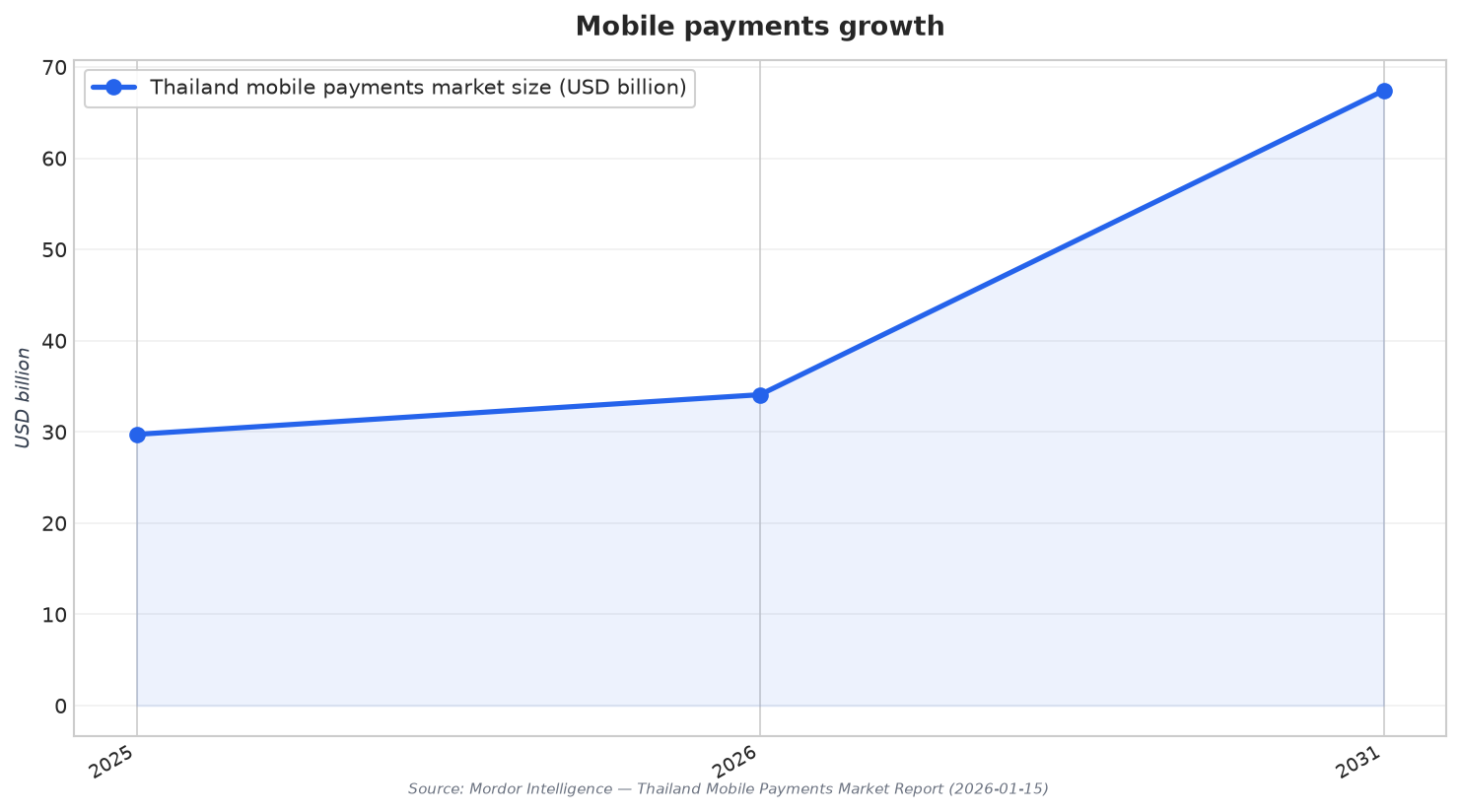
Thailand’s e-wallet ecosystem is moving from novelty to habit, because the country’s digital-payment stack is now built around interoperable rails and simple user experiences. In the Thailand mobile payments market, Mordor Intelligence estimates value of USD 29.73 billion in 2025 and USD 34.08 billion in 2026, with projections reaching USD 67.41 billion by 2031 at a 14.62% CAGR over 2026–2031. The same report ties momentum to universal PromptPay rails, 90% smartphone penetration, and a nationwide 5G rollout. It also notes frictions that keep the growth curve realistic, including rising cybersecurity incidents, rural cash affinity, and compliance costs for micro-merchants.
PromptPay is not just a transfer tool; it is the underlying behavior shift that makes wallets sticky for everyday spending. The Nation reports that PromptPay registrations surged 14% to over 90 million, with daily transactions exceeding 74 million. Antom adds detail on the value flowing through these rails: in 2023, Thailand’s mobile banking transactions totaled approximately THB 71.07 trillion, and PromptPay accounted for about THB 47.42 trillion of that amount. Those volumes help explain why wallet providers can build “pay by QR” and in-app checkout experiences on top of familiar account-to-account behavior, rather than forcing consumers to relearn payments from scratch.
QR Ubiquity and Proximity Spend Pull Wallets Into Daily Life
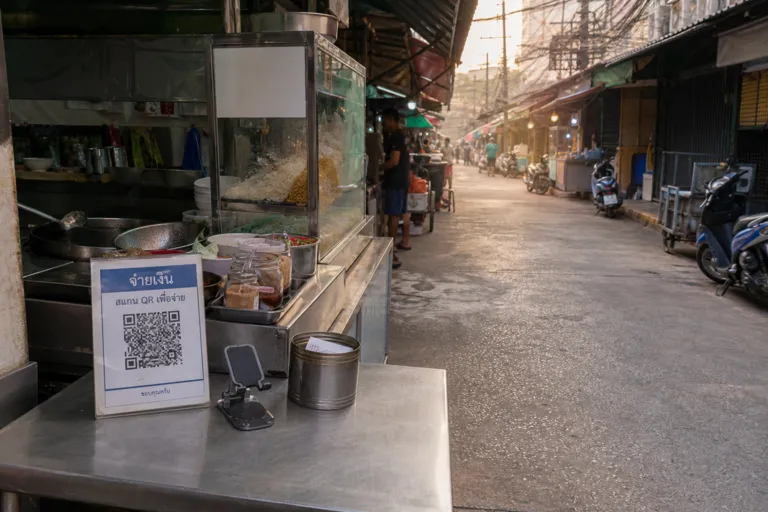
Everyday adoption depends on acceptance and use cases, and Thailand’s market data shows both expanding. Mordor Intelligence states that QR code solutions commanded 42.15% of the Thailand mobile payments market size in 2025, and proximity payments accounted for 59.10% of 2025 value. That mix fits daily routines in retail and FMCG, which contributed 33.20% of 2025 value in the same report. For consumers, Antom describes digital wallets as the second most commonly used payment method in e-commerce and POS transactions, behind bank transfers. For merchants, lower entry barriers and quick checkout behavior make wallets practical for small-ticket, high-frequency purchases.
Online commerce continues to feed offline wallet habits. Mordor Intelligence reports that e-commerce led transaction channels with a 46.25% revenue share in 2025, while remote payments are the fastest-growing payment type at a 15.3% CAGR. It also forecasts that mobile wallets will climb at a 16.2% CAGR through 2031, while P2P transfers are projected to post a 16.6% CAGR to 2031. Ken Research similarly describes mobile wallets as the leading segment in Thailand’s mobile payments market, supported by integration with retail and e-commerce platforms. Together, these figures show a market where wallets grow not only through promotions, but because they match the way people shop.
Competition is rising as regulation and investment reshape the playing field around the Thailand e-wallet market. Mordor Intelligence notes government approval of three virtual-bank consortia, plus foreign strategic investment such as MUFG’s USD 195 million infusion into Ascend Money. Ken Research highlights Thailand’s 2023 “Digital Payment Roadmap,” which aims to promote secure digital payment systems nationwide. In the adjacent remittance-and-wallet segment, Ken Research values Thailand’s digital remittance and wallet services market at USD 15 billion and points to 2023 regulations, including the Digital Payment Act, to enhance cybersecurity and data protection. The result is a maturing market where scale is built on trust as much as convenience.
What is driving the shift to everyday cashless spending in Thailand?
How large are PromptPay registrations and daily usage?
Which channels and technologies lead Thailand’s mobile payments activity?
What growth rates are projected for wallets and transfers?
How is Thailand’s e-wallet market becoming more competitive and regulated?