
Thailand’s tuna exporters are preparing for another unsettled year as trade policy and input costs collide. The Thai Tuna Industry Association (TTIA) described 2025 as a “rollercoaster year” and said 2026 performance is expected to stay within a plus-or-minus 5% range. The headwinds it cited were practical and immediate: uncertainty around US tariffs, instability in the Middle East, sharply higher raw material costs, rising packaging prices, and weakening consumer purchasing power. Together, those factors are forcing exporters to plan around multiple scenarios instead of a single baseline.
For sellers focused on the US, tariff mechanics have become a central pricing variable. A 2026 tariff summary for Thailand-origin canned tuna (HTS 1604.14) lists an MFN rate of 12.5%, with IEEPA adding 10% to 36%. During a 90-day IEEPA pause, the effective rate is described as 22.5% (12.5% + 10%). If the pause expires and a 36% IEEPA rate applies, the combined post-pause rate is stated as 48.5%. The same source illustrates impact on a procurement program: on $10M of Thailand-origin canned tuna, duty is $2.25M at 22.5% versus $4.85M at 48.5%, a $2.6M delta.
Raw Material Volatility Meets Demand Shifts
Cost volatility is also coming from the fishing and raw material side, where Thailand’s skipjack market has been unstable amid tariff uncertainty. Expana reported that the latest Thai skipjack price was assessed at $1,550 per metric ton at the end of July, up 3.3% month over month. Market participants linked the move to the ongoing Fish Aggregating Device (FAD) ban continuing until August and a slowdown in landings. The same report noted that purchasing activity for canned tuna in Thailand was affected in recent months by negotiations related to US tariffs, making procurement timing and inventory decisions harder to standardize.
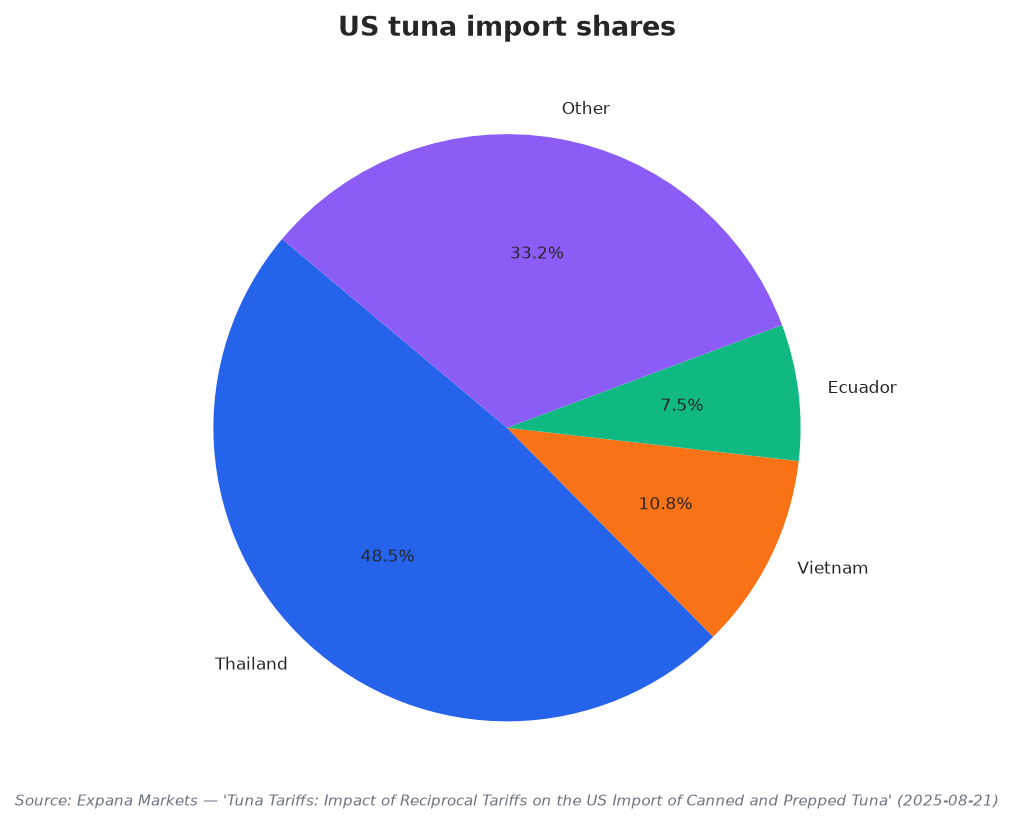
Even as tariffs create uncertainty, the US import market has shown clear shifts in buying patterns. Expana estimates the US annually imports approximately 100,000 metric tons of canned or prepared tuna from 39 countries, with Thailand, Vietnam, and Ecuador as leading suppliers in 2024. It listed market shares of 48.5% for Thailand, 10.8% for Vietnam, and 7.5% for Ecuador. Ahead of reciprocal tariffs, it also recorded an increase in purchasing activity, with overall US imports up 18.5% year to date (January to June). Over that period, imports from Thailand rose 19.8%, Vietnam 30.0%, and Ecuador 61.6%.
Exporters also have to manage documentation risk, not just pricing risk. A 2026 trade compliance outlook noted that canned tuna is among significant Thai export products that have been subject to origin verification inquiries. It emphasized that authorities now expect more than a Certificate of Origin, recommending records such as bills of materials, supplier declarations, raw material invoices, cost breakdowns, and production and labor records showing the work took place in Thailand. In parallel, market intelligence signals continued activity around Thai supply: Tridge’s 2026 overview highlighted top year-over-year shifts in supplier transactions, including Thailand at +31.9%, alongside Malaysia at +172.4% and China at -18.2%.
What performance range is expected for Thailand’s canned tuna sector in 2026?
How high could US duties go on Thailand-origin canned tuna under the cited tariff structure?
What was the reported Thai skipjack benchmark price and monthly change?
What did US import data show ahead of the reciprocal tariffs?
How is the Thailand canned tuna industry responding to rising origin-compliance scrutiny?