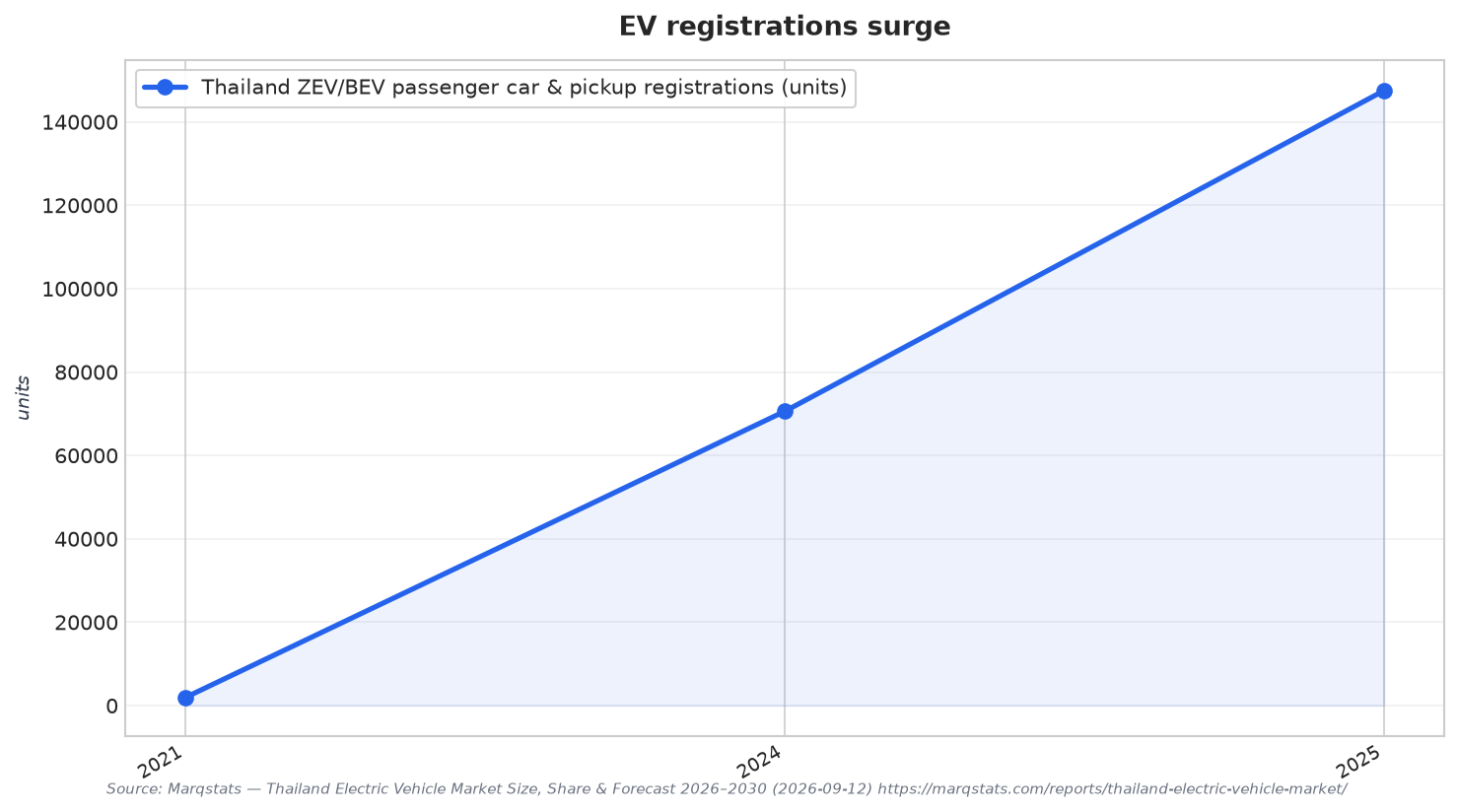
Thailand’s shift toward electric mobility is changing what vehicle owners expect from maintenance and repair. Verified administrative data from the Department of Land Transport shows ZEV passenger car and pickup registrations rising from 1,958 units in 2021 to 70,582 in 2024, while market share climbed from 0.25% to 10.87% even as the total passenger car and pickup market contracted sharply. One report also notes BEV registrations in 2025 rose approximately 53% year-on-year to around 147,500 units. For service networks, that growth signals a larger installed base that needs different inspection routines, electronics-aware diagnostics, and more structured service capacity planning than legacy ICE fleets.
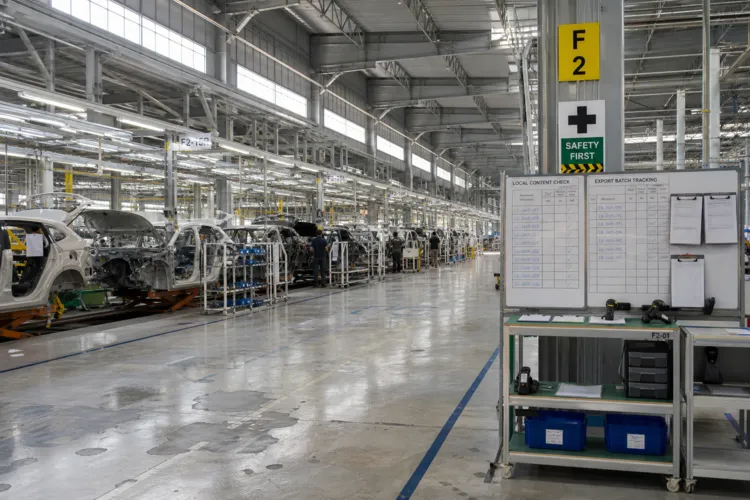
This EV expansion sits alongside a manufacturing push that can reshape parts and repair supply chains. Thailand’s EV 3.0 and EV 3.5 policy packages are described as localisation mechanisms that link tax reductions and import duty cuts to production obligations. OEM investments cited include BYD’s Rayong plant with 150,000 vehicles/year capacity and approximately 10,000 jobs, completed in 16 months, plus Changan’s THB 10 billion Rayong NEV production base, Neta’s 20,000-unit factory, and GAC Aion’s 50,000-unit plant. As Thailand transitions from an EV import market toward a regional production node, aftermarket networks can plan around a growing local ecosystem for vehicles, components, and technical know-how.
Connected Cars and Charging Growth Change the Service Playbook
EV-ready servicing increasingly depends on connectivity and infrastructure, not only mechanical skill. Thailand’s automotive telematics market was valued at USD 32.7 million in 2025 and is projected to reach USD 75.0 million by 2030, a 12.6% CAGR, with fleet management and insurance telematics applications highlighted as leading adoption areas. In parallel, Thailand’s EV charging market was valued at USD 203.52 million in 2022 and is predicted to reach USD 1545 million by 2030, at a CAGR of 29.5% from 2023 to 2030. As more chargers incorporate smart meters, cellular connectivity, and network access, aftermarket service networks must coordinate software checks, connectivity diagnostics, and charging-related customer complaints as routine work.
The competitive pace of new models adds urgency to training and tooling. At the 47th Bangkok International Motor Show (March 2026), BYD launched four models simultaneously, with prices starting from THB 429,900. Honda’s e:N2 attracted over 2,500 pre-bookings. Mercedes-Benz launched the locally assembled CLA 250+ electric with a 792 km WLTP range, while BMW showcased the Neue Klasse iX3. MG set a 30,000-unit 2026 sales target and discussed exports of Thailand-produced vehicles to Europe. Each new model wave increases variation in batteries, software, and onboard systems, pushing workshops toward standardized processes and consistent parts sourcing.
Against this backdrop, the Thailand automotive aftermarket is also being pulled by channel shifts and a changing parc profile. One market overview notes customers’ growing preference to purchase vehicle parts online due to convenience, alongside segmentation by offline and online channels. It also states the market is driven by a large vehicle-in-operation base, increasing average vehicle age, and that millions of vehicles are out of warranty in 2025. EV growth does not erase those realities; it adds another layer. Service networks that can bridge legacy demand with EV diagnostics, connected-vehicle workflows, and charging-linked maintenance will be better positioned as Thailand’s vehicle mix evolves.
What signals that Thailand’s EV parc is growing fast enough to reshape service networks?
How does charging infrastructure growth affect aftermarket repair and maintenance workflows?
What local EV production investments could influence parts availability and service readiness?
How is connected-vehicle adoption developing in Thailand, and why does it matter for servicing?
How is Thailand’s automotive aftermarket adapting as EVs grow alongside older vehicles?