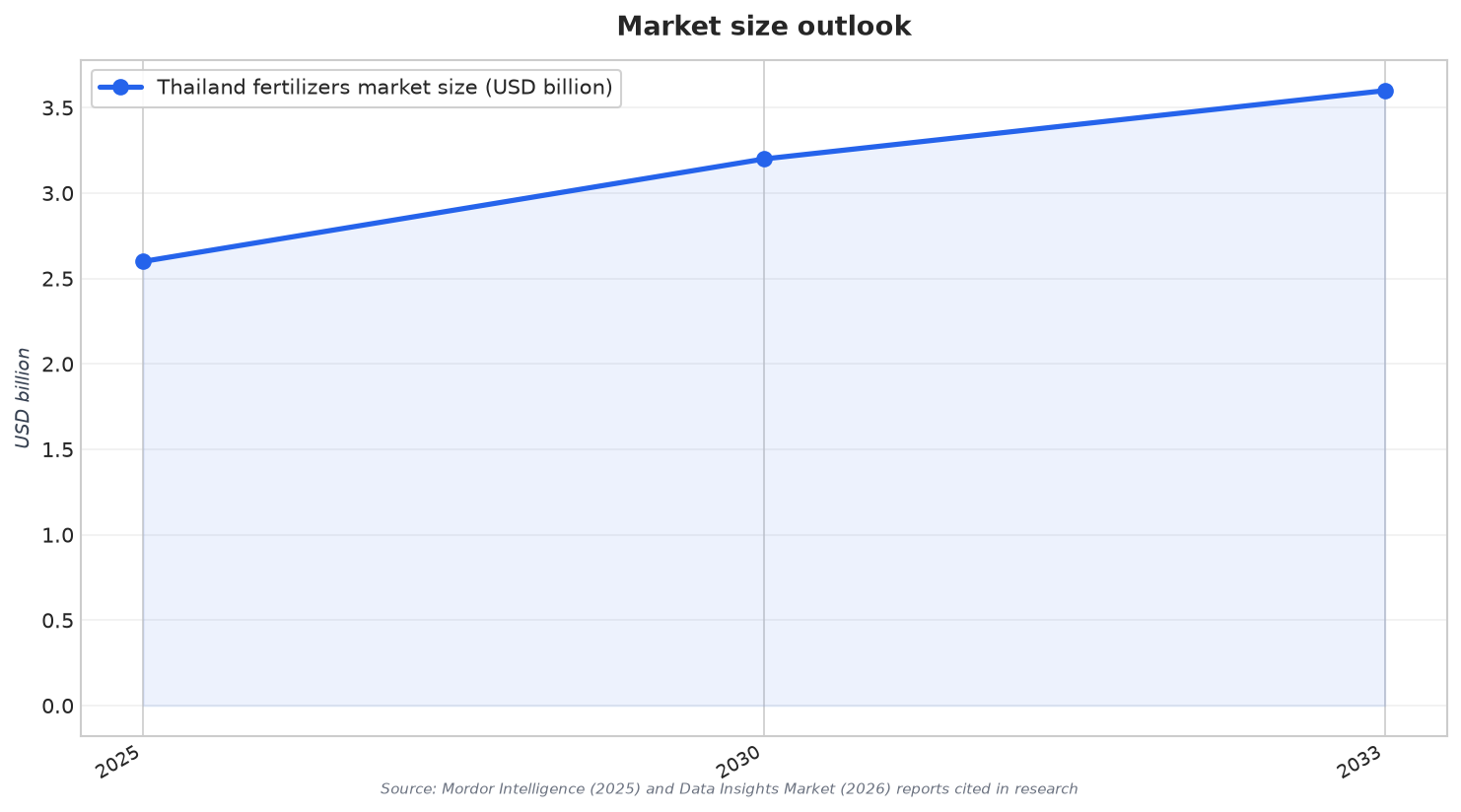
Thailand’s fertilizer market reached USD 2.60 billion in 2025 and is projected to grow at a 4.24% CAGR to USD 3.20 billion by 2030. This growth sits alongside export-driven crop pressure. Thailand’s rice exports reached 9.9 million metric tons, up 13%, and the highest level since 2018. In 2024, rice export value rose 27% to USD 6.4 billion (225.6 billion baht). Fertilizers remained essential for maintaining high output, but they also became a major cost variable as international shocks lifted price volatility across supply chains.
Cost pressure is amplified by Thailand’s import exposure. Industry participants have described the country as 100% reliant on imported fertilisers, leaving 16 million farmers exposed to global volatility and geopolitical disruption. In nitrogen, import dependence is commonly estimated at 80-90% of nitrogen nutrient supply, making logistics and trade terms central to stability. During supply disruptions, fertilizer prices were reported to range from USD 400 to USD 1,200 per metric ton in 2024. Thailand has used direct subsidies and price controls to protect farmers from these swings, yet this approach can reduce producer margins and intensify competition among importers and blenders.
Where the Reshuffle Is Happening: Imports, Blending, and Market Share
The reshuffle is visible in product mix, import flows, and how value is captured. Nitrogenous fertilizers led with 56.5% of market share in 2024, while grains and cereals represented 42.1% of market size. The competitive landscape is also fragmented. The top five companies—Thai Central Chemical Public Co., Ltd., Yara International ASA, Charoen Pokphand Group (Chia Tai Co., Ltd.), ICP Fertilizer Co., Ltd., and TCC Group (Terragro Fertilizer Co., Ltd.)—held a combined 29.9% share in 2024. That leaves meaningful room for new entrants, particularly those focused on sourcing, blending, and distribution rather than fully integrated manufacturing.
Compound fertilizers underline why new entrants can compete on procurement and formulation. In mixed NPK, Thailand’s 2023 import value was $408 million, with imports down by 7%. Imports previously peaked at 1.2M tons in 2013, then remained lower from 2014 to 2023. At the same time, the market spans many formulations, including standard grades such as 15-15-15 and 16-16-16 and crop-specific blends. Total fertilizer consumption has historically ranged around 4-5 million tonnes per year across all categories, while mixed NPK grades are estimated at 35-50% of that volume depending on season and prices. This encourages a portfolio approach where newcomers compete by grade selection and reliable delivery.
Policy and investment signals are also shifting cost expectations and entry strategies. Thailand is advancing a USD 1.8 billion potash project planned for 2026 to reduce dependency on imported raw materials. Carbon-credit incentives aligned with a national commitment to reduce emissions by 20-25% are encouraging adoption of low-emission fertilizer variants. On farms, contract farming collectives piloting zone-specific dosing reported compressing per-hectare urea volumes by 15-20% without yield sacrifice. Together, these changes reinforce why the Thailand fertilizer industry is being reorganized around supply security, differentiated products, and procurement advantages that can quickly translate into lower or more stable farm input costs.
How large is Thailand’s fertilizer market, and what growth is projected?
How volatile can fertilizer prices get during disruptions affecting Thailand?
What shows that competition leaves room for new entrants in the Thailand fertilizer industry?
What do recent figures show about Thailand’s NPK import trends?
What changes are influencing future fertilizer costs and usage in Thailand?