Thailand’s EV 3.5 package (2024–2027) is designed to speed up EV adoption while forcing supply chain localization. The policy reduces excise tax on eligible battery EVs to 2 percent and continues consumer support. For mass-market passenger cars priced below THB 2 million, rebates are THB 100,000 in 2024 and THB 75,000 in 2025 when battery capacity is at least 50 kWh, with proportionately lower support for smaller batteries. This demand-side push matters for battery investors because domestic EV registrations reached about 70,000 units in 2024, rising from fewer than 10,000 in 2021, signaling faster pull-through for locally made packs, modules, and cells.
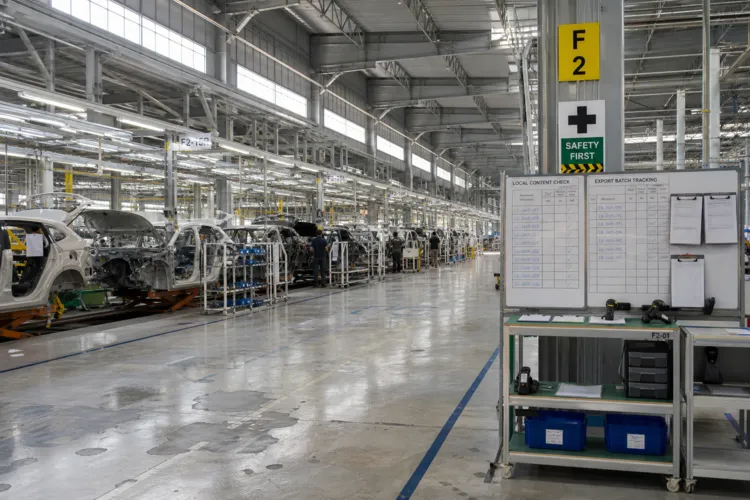
EV 3.5 also ties short-term import relief to strict build commitments that shape the near-term pipeline for local assembly and component sourcing. From 2026, manufacturers must assemble two vehicles in Thailand for every one imported, and by 2027 the ratio rises to three to one. Since mid-2025, exports of locally built EVs can count toward these obligations, improving flexibility for companies that want Thailand as a production and export base. Separately, an ASEAN-focused market view notes a revised 2025 subsidy approach that awards 1.5 credits for each exported EV, reinforcing the export logic while keeping localization pressure in place.
Where Battery Investors Fit: Grants, Standards, and BOI Privileges
For Thailand EV battery manufacturing, the investment story is not only assembly volume. Battery makers can access direct support through the national competitiveness fund, but projects must meet performance thresholds of at least 150 Wh/kg energy density and 1,000 cycles of durability under standard testing. Applications remain open until the end of 2027, and each project must secure cabinet approval before grants are disbursed. BOI promotion can add corporate income tax holidays for up to eight years, with potential additional years for projects meeting merit criteria, alongside non-tax benefits such as 100 percent foreign ownership, land acquisition for promoted activities, and streamlined visas and work permits.
Approved investment figures highlight how much of the EV supply chain is already being financed, and where batteries sit in that stack. As of end-June 2025, cumulative approved investments in electric vehicles, key components, charging systems, and battery swapping services totaled 137.7 billion baht (about USD 4.2 billion). Within that total, battery production accounted for 53 projects covering battery module production and battery cell manufacturing, representing 80.1 billion baht. On the demand side, under EV 3.0 and EV 3.5, 175,064 BEV cars and 34,559 electric motorcycles had been granted subsidies totaling over 12 billion baht, helping explain why investors are treating local battery capacity as a strategic bottleneck to solve.
Investors still need to plan for compliance and competitive pressure. To access BOI-linked benefits, companies must sign an agreement with the Excise Department, lodge a bank guarantee, obtain Thai Industrial Standards certification, and complete testing at the Automotive and Tire Testing Research and Innovation Center or an equivalent international facility. Policy commentators also flag price pressure from China’s EV oversupply, which can widen cost gaps and force weaker players out, even as Thailand’s EV momentum continues. Between January and September 2025, EV registrations rose 59 percent versus the same period in 2024, and as of 31 October 2025, a total of 238,000 EVs had been registered under EV 3.0 and EV 3.5, alongside 140 billion THB in cumulative investments from 32 EV 3.0 and 11 EV 3.5 manufacturers.
What does the BOI EV 3.5 scheme require for local production?
What consumer incentives in EV 3.5 can support battery demand?
What performance thresholds apply to battery projects seeking direct support?
What approved investment has already been recorded for battery production in Thailand?
How is Thailand EV battery manufacturing being shaped by EV demand and registrations?