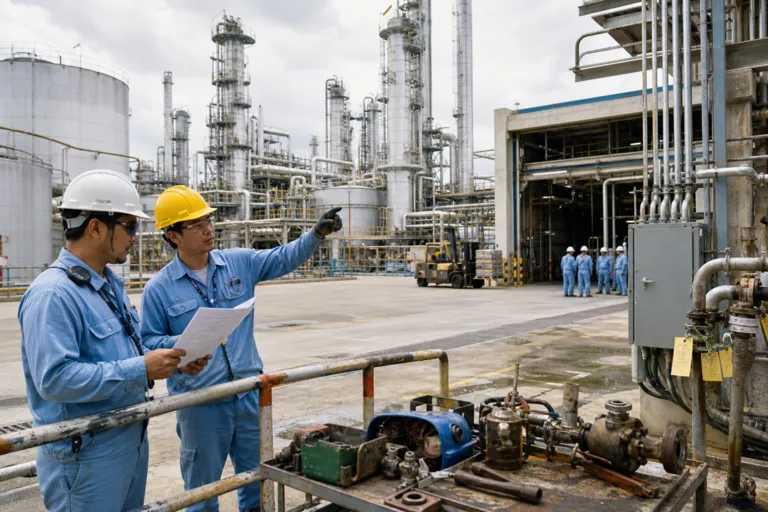
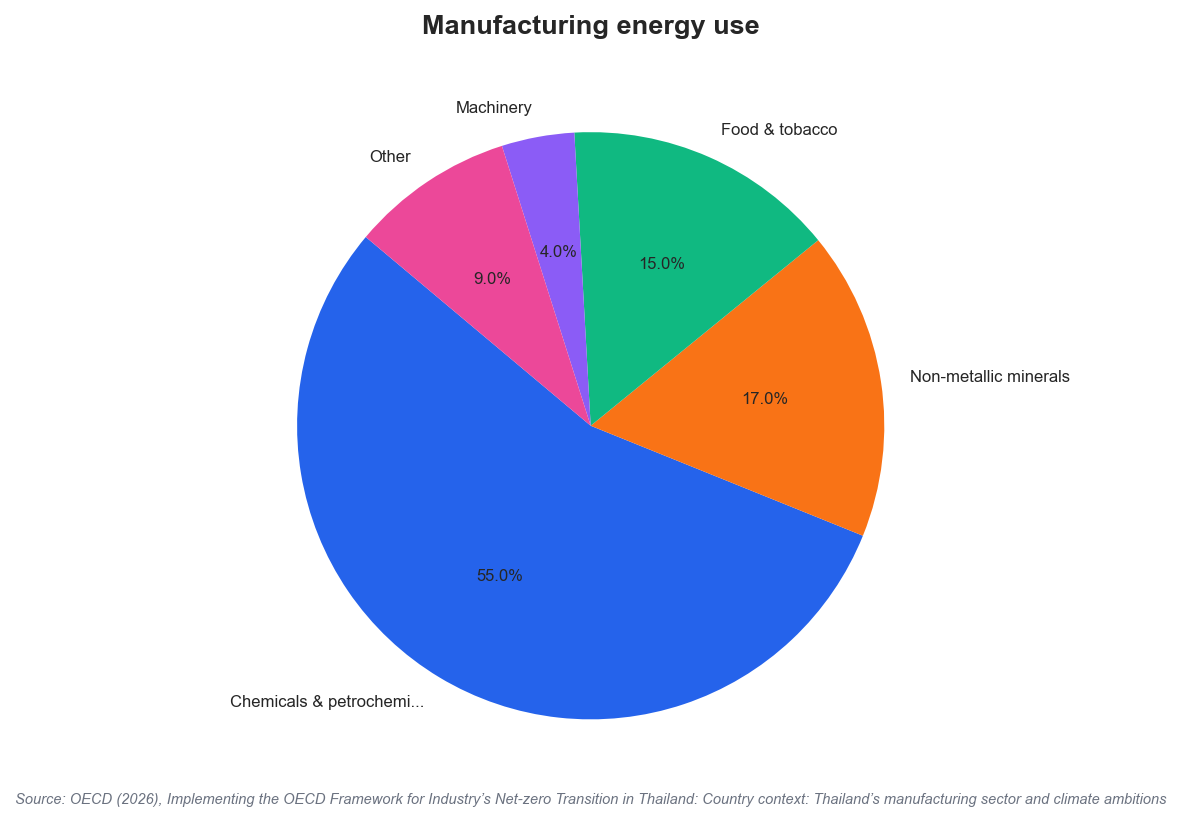
Thailand’s petrochemical and plastics value chain sits at the centre of the country’s manufacturing ambitions. The OECD notes that Thailand aims to position itself as a regional leader in sustainable industry and innovation under the Bio-Circular-Green Economy Model, and it highlights the strategic importance of petrochemicals and plastics for Thailand’s economy and employment. In the wider manufacturing energy picture, chemicals and petrochemicals rank first for final consumption at 55%, which the OECD links mainly to fossil fuels used as raw materials for petrochemicals and plastics production. This starting point helps explain why the sector’s green transition is not optional, and why it comes with complex trade-offs for operations, costs, and competitiveness.
Operational strain can also arrive suddenly from outside Thailand. Industrial Info reports that a recent conflict in the Middle East led to the closure of the Strait of Hormuz, shifting the country’s petrochemical outlook from prospective growth to a heavy operational burden. The impact split plants between those that are natural gas-based and those that rely on imported naphtha. SCG Chemical’s Rayong Olefins (ROC) suspended operations and declared force majeure due to a shortfall in naphtha and propane feedstock imported via the Strait of Hormuz. The same source lists ROC capacities of 900,000 MT/yr ethylene, 450,000 MT/yr propylene, 150,000 MT/yr benzene, and 70,000 MT/yr toluene, underlining the scale of disruption when feedstock access tightens.
Overcapacity Pressures Meet Transition Investment Needs
Overcapacity is a broader backdrop that shapes decision-making even when plants are not hit by immediate supply shocks. Wood Mackenzie describes “persistent overcapacity” and “weak demand” alongside sustainability pressures, arguing these forces are resulting in multiple plant closures globally. It also says overcapacity and depressed profitability, combined with rising capital demand for the energy transition and regulatory requirements, are pushing companies toward bold strategy, innovation, and partnership. For Thailand’s petrochemical industry, that combination matters because net-zero and circularity demands require investment at the same time that oversupply can pressure margins. The result is a sharper need to choose where to run, where to upgrade, and where to reduce exposure to higher-risk assets.
Thailand’s own transition pathway ties directly into industrial structure and jobs. The OECD reports that as of 2023, the food sector was the largest employer within manufacturing at 24% of the workforce, followed by chemicals and petrochemicals at 14% and textiles at 9%. The OECD also flags that increased automation and mechanisation may reduce reliance on human labour, a point that becomes more relevant as companies pursue efficiency and lower emissions. In parallel, Mordor Intelligence’s downstream outlook suggests operators are already “optimizing utilization rates” and that “feedstock-flexible petrochemical units are pivoting toward higher-margin specialty chemicals.” This operational pivot fits a period where firms must balance resilience, profitability, and decarbonisation priorities.
Company-level responses to stress show why feedstock strategy is becoming a competitiveness lever. Industrial Info says SCG Chemical halted ROC to protect the larger Map Ta Phut Olefins (MOC) complex, and diverted available feedstocks to maintain MOC production of 1.2M MT/yr ethylene and 850,000 MT/yr propylene. It adds that MOC remained active at an 80% reduced utilization rate, but under high risk if disruptions proceed over the next two months. In contrast, the same report says PTT Global Chemical (PTTGC) was operating at full capacity because it relies heavily on domestic ethane supplied by PTT from the Gulf of Thailand, positioning it as a resilient player during the crisis. These contrasts illustrate how Thailand’s petrochemical producers are navigating both overcapacity-era economics and the practical realities of securing reliable, lower-risk inputs while preparing for a greener industrial model.
What is driving the green transition focus in Thailand’s petrochemical sector?
How did the Strait of Hormuz disruption affect Thai petrochemical operations?
Which facilities and capacities were highlighted during the disruption?
How do overcapacity conditions influence strategy for Thailand’s petrochemical industry?
What does the OECD say about employment in chemicals and petrochemicals in Thailand?