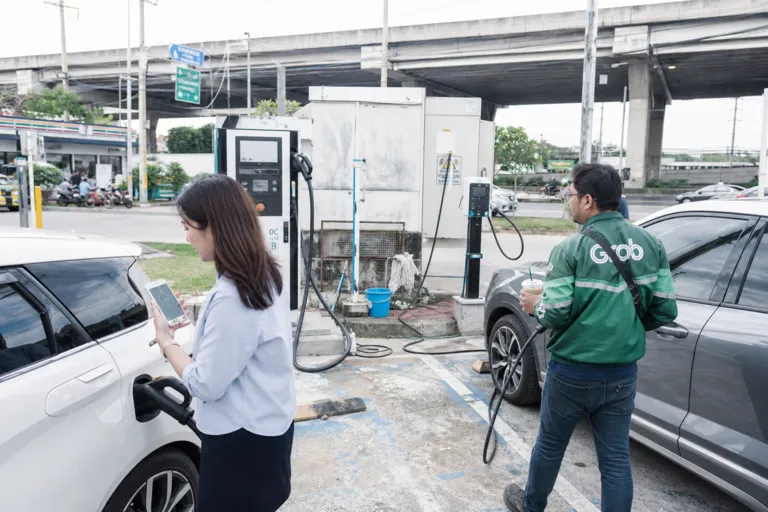
Thailand’s push toward mass electric vehicle adoption is now tightly linked to how fast charging access can scale in real places people drive and park. Under the EV 3.0 policy, Thailand aims to produce 1.12 million ZEVs by 2030 and 3.04 million by 2035. As of 2024, the country had 700,000 accumulated EV registrations, equal to 1.5% of all registered vehicles. Passenger cars represented 90% of registered EVs, followed by motorcycles at 9.4% and buses at 0.4%. These figures underline why charging availability, speed, and reliability matter across segments, especially as heavier-duty categories face steeper growth demands.
The public network is already substantial, and multiple sources point to rapid build-out through 2024 and 2025. Data cited by Roland Berger from the Electric Vehicle Association of Thailand says that as of December 2024 there were 11,467 charging points nationwide, split between 5,685 AC and 5,782 DC. For a later snapshot, GM Insights reports that by March 2025 Thailand had over 3,700 public charging stations offering 11,600 connectors, including more than 6,000 fast (DC) chargers. Taken together, these numbers highlight a clear direction: more connectors, more DC capacity, and an accelerating effort to keep user satisfaction high while preventing infrastructure from falling behind national ambitions.
What Has to Change to Support Mass-Market Daily Driving
Scaling is not only about adding locations. It is also about deploying the right charging types in the right settings. Nexdigm’s market coverage segments Thailand’s EV charging infrastructure into fast charging systems, slow charging systems, wireless charging systems, AC charging systems, and DC charging systems, and notes that fast charging systems have a dominant market share due to demand for shorter charging times and advancements in charging technology. On the “where,” Nexdigm also describes urban charging stations as the dominant platform type, driven by high-traffic placement and demand in cities such as Bangkok. The same research points to Bangkok, Chiang Mai, and Phuket as leading hubs for infrastructure development, tied to higher EV adoption rates and local support.
Thailand’s EV charging market expansion is also being shaped by who installs and operates stations, and how services are packaged for drivers. NextMSC estimates the Thailand Electric Vehicle (EV) Charging Market at USD 203.52 million in 2022, and predicts it will reach USD 1,545 million by 2030, at a CAGR of 29.5% from 2023 to 2030. The same source describes market participants launching advanced charging solutions and forging collaborative agreements to expand networks, raise operational efficiency, and reduce charging times. It also highlights that EV charging penetration is higher in commercial spaces than residential ones, while residential charging still offers growth potential due to affordability and convenience. This mix suggests that mass adoption will rely on both public fast charging for corridors and daily top-ups at home or in shared residential complexes.
Policy momentum is a major tailwind, but it also increases pressure on rollout speed and coverage. REGlobal notes that Thailand’s National EV Roadmap aims for 30% of all vehicles produced domestically to be electric by 2030, while also emphasizing constraints such as high upfront costs and insufficient charging infrastructure. Nexdigm’s Thailand EV industry analysis adds that the country has seen a rapid increase in charging stations across highways, shopping malls, and residential complexes, with both private companies and state-owned energy firms investing in fast-charging networks to address range anxiety. In practice, scaling Thailand EV charging infrastructure for mass adoption means aligning urban density, highway coverage, and charging speed with the country’s production and registration trajectory.
How large is Thailand’s public charging network today?
Why is fast charging so important for mass EV adoption in Thailand?
Which areas are leading the rollout of charging stations?
What do Thailand’s EV targets imply for charging build-out?
What is the outlook for Thailand EV charging infrastructure investment?