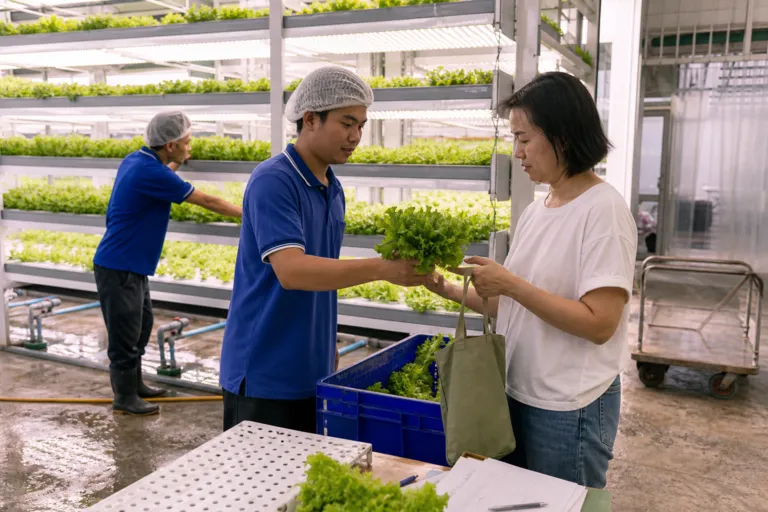
Thailand’s vertical farming and indoor agriculture discussion is gaining momentum as urban demand for fresher produce rises and retailers look for shorter, more reliable supply chains. Vertical farming is an advanced technique that grows crops in vertically stacked layers inside controlled environments such as warehouses or high-rise buildings, using tools like hydroponics, aeroponics, and artificial lighting. Across the Asia Pacific region, vertical farming is increasingly gaining traction due to rapid urbanization, shrinking arable land, and growing concerns over food security. These same forces matter for Thailand’s major cities, where year-round availability and consistent quality can carry a premium.
From an operations perspective, vertical farming is positioned as a way to reduce water usage, land dependency, pesticide use, and food miles, while enabling high-yield production in small urban spaces. Indoor farming more broadly is also described as responding to rising demand for year-round food production, urbanization, water scarcity, and sustainable agriculture solutions. One cited benchmark is that indoor farming can use up to 95% less water than field agriculture and reduce reliance on chemical pesticides. This framing aligns with why the Thailand vertical farming market is often discussed as an urban-adjacent solution: it targets freshness, predictable output, and controlled production conditions rather than depending on climate and soil.
What’s Powering Indoor Agriculture Momentum—and What Holds It Back
Globally, indoor farming is scaling in ways that shape technology availability and business expectations for Thailand. One forecast values the global indoor farming market at USD 49.4 billion in 2025, reaching USD 54.4 billion by 2026-end and growing at a CAGR of 10.1% between 2026–2036 to reach USD 142.4 billion by 2036. In that view, hardware leads with a 60.0% share, and crop production leads applications with a 55.0% share. Hydroponics is also positioned as the leading growing system with a 60.0% market share, due to water efficiency and precise nutrient control, especially for leafy greens and herbs that fit premium urban demand.
Urban-centered economics show up repeatedly in the sources. Indoor farming can reduce last-mile logistics costs and deliver produce within 24 hours of harvest, which supports “freshness premiums” in metropolitan markets. At the same time, the Asia Pacific vertical farming outlook flags a major constraint: high energy consumption in indoor agricultural systems, which raises sustainability and operational cost concerns. Another analysis notes that energy costs per kilogram of produce are continuing to fall due to better efficiency of LED lighting and falling prices, helping unit economics move closer to breakeven. For Thailand, these dynamics point to a balancing act: the case for local, fast-harvest supply is strong, but electricity costs and energy efficiency choices can determine viability.
Examples from other countries show how vertical farming and indoor agriculture can be embedded into dense urban life—useful context without being direct Thailand data. In Tokyo, urban farms like Pasona O2 operate inside office buildings, supplying fresh produce directly to employees and nearby residents. In China, companies such as Bright Farms have established vertical farming hubs near Shanghai and Beijing to serve high-demand urban markets. Together with the global market trajectory and the emphasis on hydroponics, LEDs, HVAC, and nutrient delivery infrastructure, the takeaway for Thailand is practical: as city demand concentrates food consumption, controlled-environment farms can compete on freshness and reliability—if energy and operating costs are managed well.
What is vertical farming, and why is it relevant for Thailand’s cities?
What benefits do sources attribute to indoor farming systems?
What is a key constraint for the Asia Pacific vertical farming market?
How do global forecasts frame the growth outlook for indoor farming?
What’s shaping the Thailand vertical farming market discussion today?