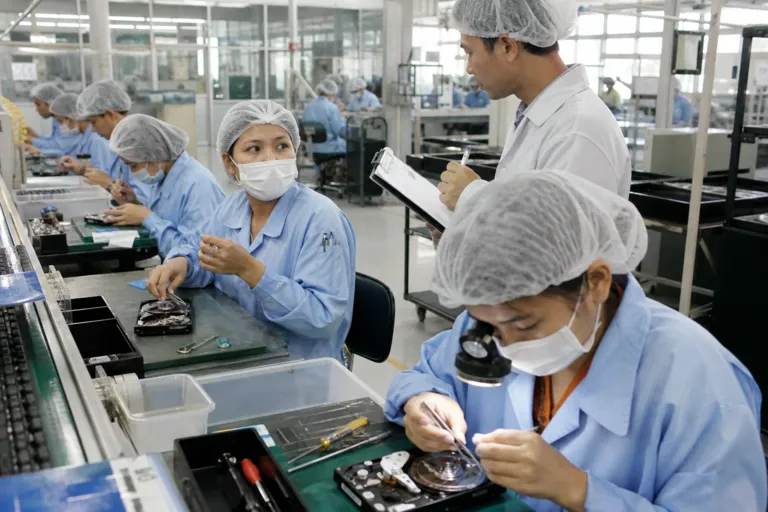
AI is changing the storage math for data centers, and that shift is helping explain why HDD demand has rebounded. Forbes contributor Tom Coughlin describes a demand surge in 2021, followed by a big slump in 2022 and 2023 as data centers worked down inventory. He then points to capacity demand rebounding in 2024 and through 2025, driven by a return to ordinary demand plus incremental demand tied to AI training buildouts. In that context, Thailand hard disk drive manufacturing matters because the Asia-Pacific region leads global HDD shipments at 45%, supported by large OEM manufacturing hubs, and Thailand is explicitly cited as part of the region’s concentration of HDD manufacturing.
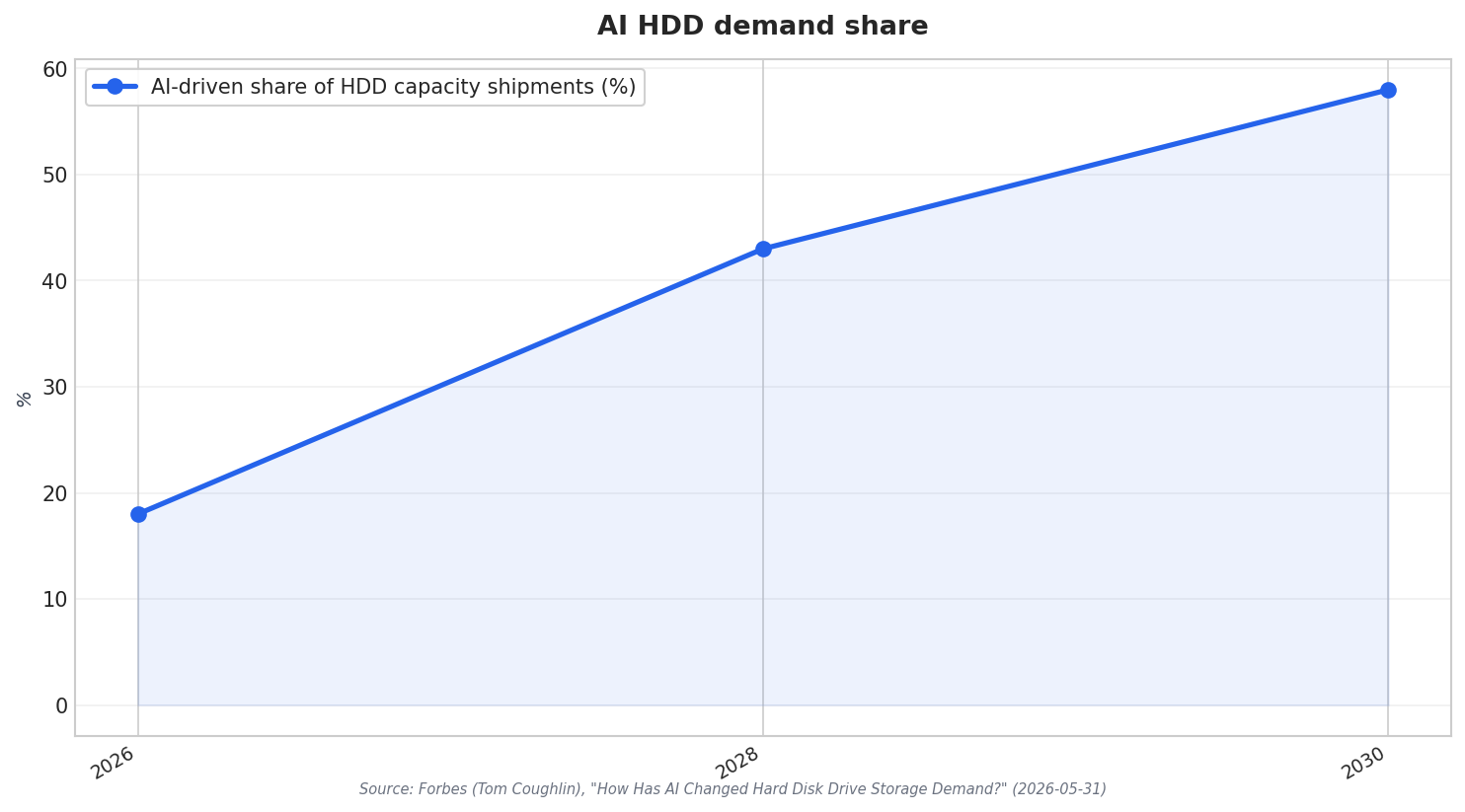
What is different this cycle is how much of the new demand shows up as capacity rather than only as unit volume. Coughlin estimates that, in 2026, storage capacity demand without AI buildout would be about 1,654 Exabytes (EB), plus about 363 EB of additional storage demand attributable to AI, or about 18% of total expected capacity shipments in 2026. His projections then show the AI-related additional HDD capacity demand rising to about 43% of total shipments in 2028 and about 58% in 2030. He also notes that more than 85% of data center data currently lives on HDDs, reinforcing why secondary storage demand stays tied to AI workflows even when SSDs lead in primary performance tiers.
Why The Rebound Favors Density Over Massive New Factories
The rebound is not only about “more drives.” It is also about “bigger drives,” and that changes the manufacturing playbook. Coughlin projects the average shipping HDD capacity will increase by about 2.7 times between 2025 and 2030, while the number of HDDs shipped in 2030 will be only about 13% higher than in 2025 (and 19% less than the number he estimates shipped in 2022). He also cites Seagate CEO Dave Mosley saying the company’s focus is on increasing storage density rather than increasing the physical number of drives produced, arguing that diverting resources to build new factories would slow technological innovation. For Thailand-based production ecosystems, that frames the opportunity around precision, yield, and technology transitions, not just expanding lines.
Market trackers add global context on where this demand is landing. One report projects global HDD shipments of approximately 278 million units in 2025, while noting average drive capacities rising from 3.6 TB in 2023 to 4.2 TB in 2025, alongside nearline enterprise HDDs holding over 68% of total exabytes shipped. It also states that the top three manufacturers hold 89% combined market share in 2025, highlighting a tightly concentrated supply chain where disruptions can ripple quickly. Another market report values the global hard disk drive market at $43.2 billion in 2025, and says Asia Pacific leads due to the concentration of HDD manufacturing in Thailand and Malaysia, along with broader regional data center expansion and digital infrastructure programs.
AI workloads also pull HDD demand through “cold data” and long retention requirements. Mordor Intelligence notes that municipalities in Malaysia and Thailand are investing billions in smart infrastructure, creating a sustained pipeline for multi-drive NVRs and centralized archival arrays, and that AI-enabled analytics can increase retention windows because raw footage must be stored alongside inference metadata for compliance verification. In parallel, Coughlin explains that HDDs serve as secondary storage for older training data, logs, and content created during AI training or inference, tracking SSD demand with a higher multiplier as repositories grow over time. Taken together, those dynamics help explain why the HDD upcycle can translate into renewed momentum for Thailand’s manufacturing footprint without requiring unit shipments to explode.
What is driving the HDD demand rebound tied to AI?
How big is the AI-related share of HDD capacity demand in 2026 and beyond?
Why does Thailand hard disk drive manufacturing matter in the global supply chain?
Is growth coming from more drives or bigger drives?
What role do HDDs play in AI storage compared with SSDs?