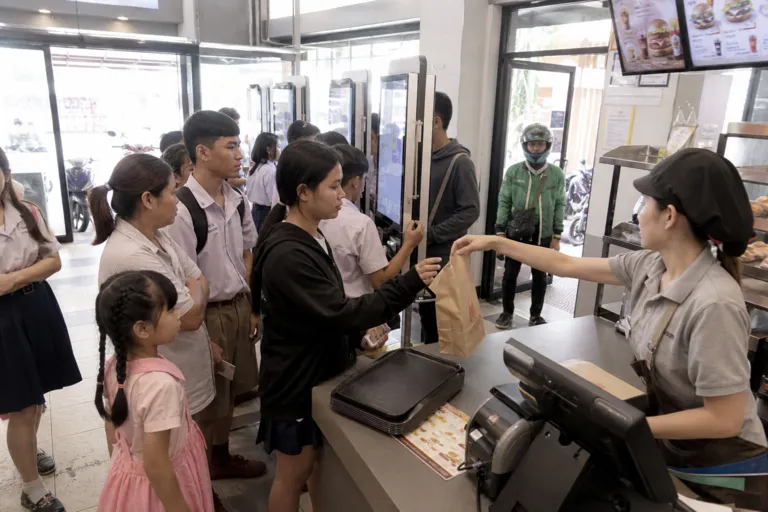
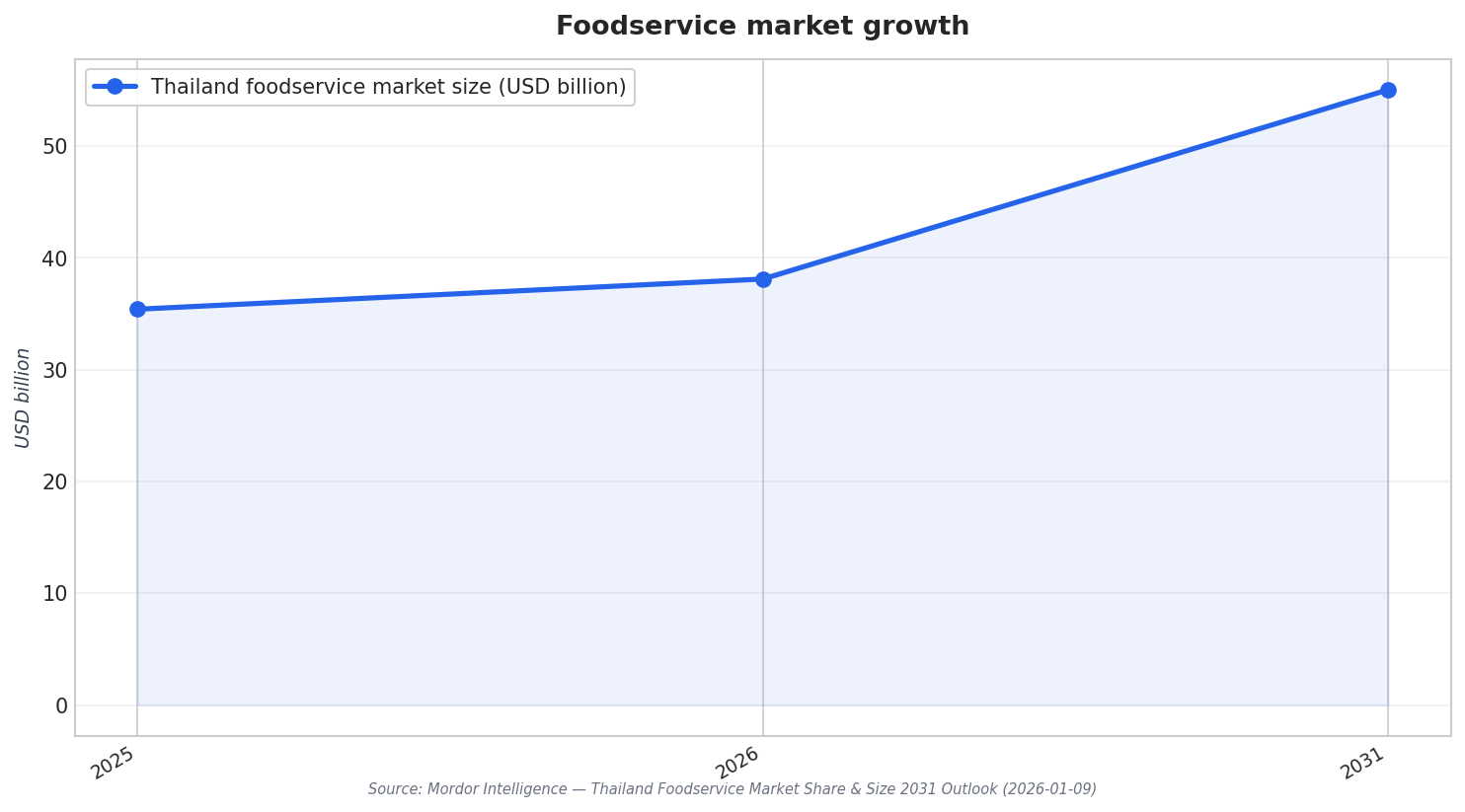
Thailand’s foodservice and retail momentum is creating a faster runway for franchised and chained restaurant formats, especially QSRs. Mordor Intelligence expects Thailand’s foodservice market to grow from USD 35.4 billion in 2025 to USD 38.1 billion in 2026, with a forecast of USD 55.03 billion by 2031 at a 7.62% CAGR over 2026–2031. In 2025, QSRs led with 50.68% of Thailand’s foodservice market share, while chained outlets are projected to expand at an 8.02% CAGR to 2031. Together, these signals point to a sector where scalable operating models and repeatable store formats are positioned to win share as demand for convenience rises.
External tracking also highlights the near-term lift coming from QSR performance. Deloitte’s Foodservice Market Monitor 2026 (reported by The Nation) put Thailand’s foodservice market at €26.8 billion in 2025, expanding 4.1% year on year, with QSRs growing 5.1% and described as the strongest-performing segment. The same report noted that street food generated the highest market value in Thailand’s foodservice sector in 2025 at more than €8.79 billion, underscoring how modern chains are scaling alongside a powerful informal food ecosystem rather than replacing it. For operators, the implication is clear: growth is available, but concepts must compete on speed, consistency, and accessibility.
Provincial Expansion Gets Easier as Digital and Retail Networks Deepen
International brands chasing provincial growth are doing so in a Thailand retail environment that is itself expanding and modernizing. Mordor Intelligence projects Thailand’s retail market to grow from USD 148.73 billion in 2025 to USD 154.17 billion in 2026, reaching USD 184.5 billion by 2031 at a 3.66% CAGR over 2026–2031. In 2025, food, beverage and tobacco accounted for 55.68% of retail market share, while convenience stores held 38.78% share and are forecast to grow at a 10.15% CAGR from 2026 to 2031. The same source notes modern trade chains extending footprints into rural provinces, supported by evolving payment systems and omnichannel integration as PromptPay usage tops 52.7 million accounts.
For the Thailand franchise and QSR industry, delivery and new production models are also widening addressable demand beyond prime mall corridors. Mordor Intelligence reports delivery is advancing at a 10.88% CAGR to 2031, while cloud kitchens are projected to surge at a 25.08% CAGR through 2031, enabling brands to reach customers without relying solely on dine-in. At the same time, standalone venues still dominated with an 89.65% share in 2025, but travel-oriented sites are forecast to grow fastest at a 10.86% CAGR over the same period. These shifts favor systems that can standardize menu execution, manage last-mile complexity, and adapt to multiple location types.
Tourism is another tailwind shaping where chains place units and how they design service models. Mordor Intelligence notes tourist arrivals rose past 35 million in 2024, helping restore footfall across major retail destinations. That demand is being met with a broader mix of formats, from convenience-led grab-and-go through to delivery-first operations. The result is a more competitive landscape in which international chains localize offerings and domestic operators strengthen omnichannel capabilities, as Mordor describes. With independent operators still commanding 73.78% of value in 2025, franchised and chained players have room to expand, but must win customers through convenience, consistent quality, and strong digital ordering experiences.
How large is Thailand’s foodservice market expected to become by 2031?
How important are QSRs within Thailand’s foodservice market?
Which channel trends support expansion beyond Bangkok into the provinces?
What growth rates are forecast for delivery and cloud kitchens in Thailand?
What does the Thailand franchise and QSR industry need to compete as chains expand?